Live Coaching Series
DOXA Agentic AI Series
Agentic AI for Business · Six missions, live every Thursday
AI Officer Institute · Hosted in AIO Labs · DOXA Talent Cohort
The promise. Over six missions you build one idea from a packaged prompt into a wired workflow, add decision logic, deploy it as an agent, and write the production brief to take it live. By the end you have a categorized roadmap, a working prototype, and a clear plan for what comes next.
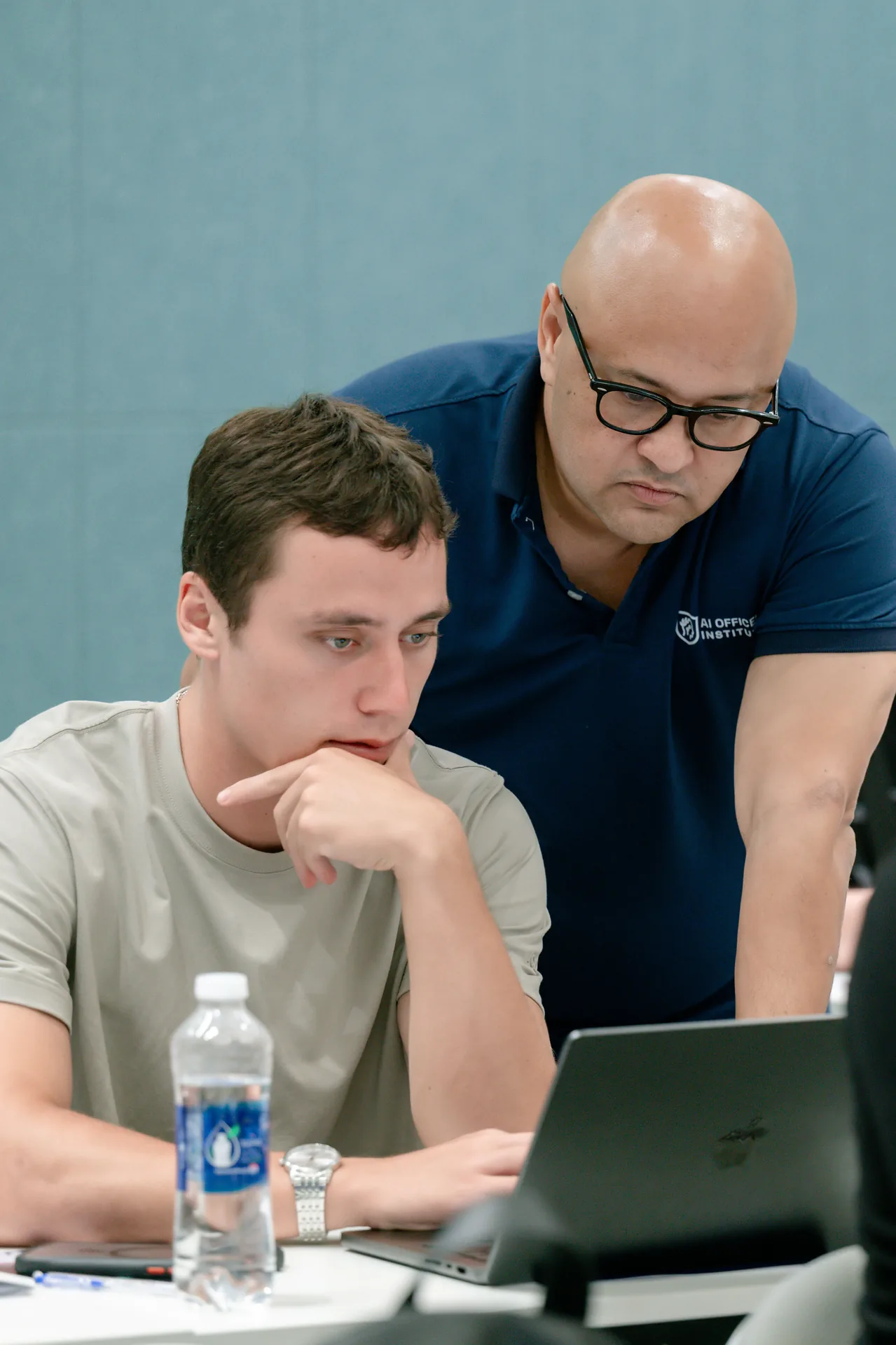
The format. 60 minutes live with David and Dave each Thursday at 5:00 AM Saigon (6:00 PM Wednesday Eastern). Bring your laptop. Bring one real problem from your business. Leave with something you can use Monday.
How It Works
- Pick one opportunity. In Mission 1 you scan your business and choose a single high-leverage opportunity to develop across the next five missions.
- Build it live. Each Thursday you work alongside the cohort. Open the workbook, paste the AI Buddy prompt into Claude, and run the activities with us.
- Ship between sessions. Test your prototype with a teammate. Bring questions to the next session. We unblock you live.
The Six Missions
Each mission has a live session and a workbook. The workbook is a single Claude prompt you paste into a new chat. Your AI Buddy walks you through the activities.
AI Program Planning
Scan your business for AI opportunities. Map them across four offices: Revenue, Talent, Innovation, and Operations. Understand the tools landscape, where AI fits, and what separates projects that deliver from ones that don't.
From Prompts to Packaged AI
Take your roadmap item and start with the prompt layer. Build something reusable, something you could hand to a teammate and they would get consistent, on-brand results without asking you a question. Vibe-code your first prototype live.
Wire the Workflow
Move beyond a single prompt into a full workflow. Map your roadmap item end to end using the 7-step Trigger Sequence: Trigger, Data, Classify, Route, Respond, Action, Log. Identify what AI handles versus what stays human.
Workbook coming soon
Teach Your Workflow to Decide
Your workflow runs. Now make it think. Add decision logic at the classification and routing steps. Define what happens for each path. Set rules for when AI decides alone and when a human reviews.
Workbook coming soon
Unleash the Agent
Build a full agentic workflow. Your agent acts on triggers, makes decisions based on the logic you designed, executes responses, logs outcomes, and escalates when it reaches the edge of its authority.
Workbook coming soon
From Prototype to Production
Draw the line between what you can lead and where you need an engineer. Your prototype works in a demo. Learn what changes when it has to run every day: data security, scale, integration, error handling, uptime.
Workbook coming soon
What You Take Home
- A categorized AI roadmap for your business, mapped across Revenue, Talent, Innovation, and Operations.
- A working agentic prototype you built yourself, tested against real scenarios, with clear boundaries.
- A production handoff brief that draws the line between what you can lead and where you need an engineer.