Every leadership program your company has ever paid for teaches one thing: how to lead people. It is now half the job. Here is how to lead AI, the other half nobody trained your managers for.
Communication, feedback, decision-making, trust. It is good work, and the best programs do it brilliantly.
It is now half the job.
A second half has appeared, and it is not optional. Your people are already working alongside AI. Some of them are building workflows that used to take a department. Most of your managers have never been taught how to lead any of it. They were trained for the half of the job that existed when they got promoted.
That gap is the most expensive thing in your org right now, and almost nobody is measuring it.
The pit stop that explains the decade
Dr. Brooks Holtom, a Georgetown professor, uses a great metaphor for change: two clips of a Formula One pit stop.
The old one: four people, old tools, fifty-seven seconds with the car sitting still. The modern one: fifteen-plus people moving as one unit, about three seconds.
Same job. The tools changed, the knowledge changed, the rules changed, and the crew re-organized around all three at once. Nobody got nostalgic about the fifty-seven-second version. They re-tooled, because the alternative was losing.
Business is in that exact moment. The question is not whether the work changes. It is whether you re-tool your people on purpose, or watch a competitor do it three seconds faster.
The comparison that makes executives sit up
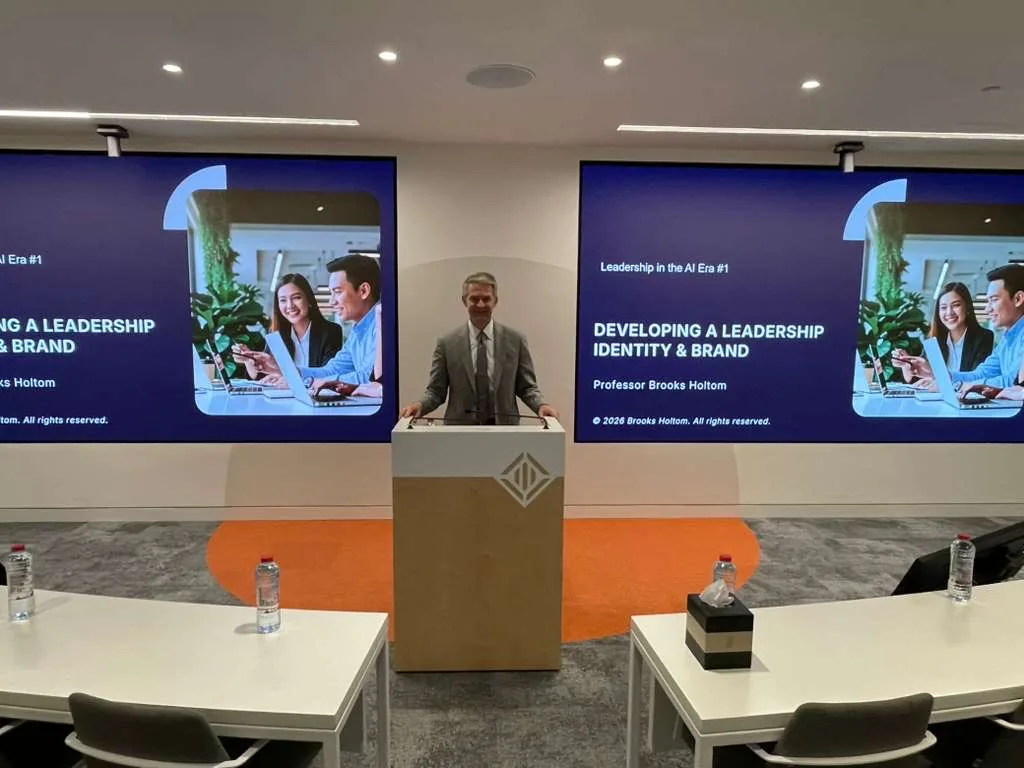
In the Lead the Organization session of our EO Vietnam pilot, one participant was working through a workflow exercise and stopped. His company had paid Deloitte for something close to what he had just built himself in an afternoon.
He is not a developer. He learned three skills.
That is the ROI question hiding inside every AI conversation. Not "should we use AI." You already are. The question is whether your people can build with it, or whether you keep paying outside firms for work your own team could own. This is the same shift we covered in how to delegate work to AI.
Two altitudes, one program
The reason most training fails here is that it pitches AI at one level and ignores the other. Leading AI looks different depending on where you sit.
Your line managers need to use AI. Generative and agentic, every day, in the actual work. They need to know how to direct it, check it, and trust it appropriately, the same way they learned to direct and check a junior hire. For them, leading AI is hands-on.
Your executives need to lead the people who use it. That means understanding what the work now is, what good looks like, where the risk lives, and how to set strategy when half your capacity is non-human. For them, leading AI is leading people through it.
Leadership in the AI Era is built for both altitudes. Same program, two entry points, so the manager and the executive come out speaking the same language about the same work. That alignment is the point. The most common failure in AI adoption is an executive and a manager who each think the other one understands it.
The three skills that have nothing to do with the tool
Here is what surprised every executive in the room. None of this is about software.
Yes, we spent a few minutes finding where the instructions live in ChatGPT versus Claude. That is trivia. It changes every quarter and it does not matter. Underneath the tool, there are three skills, and they are the whole game.
One: organizing data and information. Knowing what matters, structuring it so it can be used.
Two: building workflows. Breaking a job into steps that can be run, repeated, and handed off.
Three: writing instructions, which is really just code that AI can follow. Telling the system exactly what to do, clearly enough that it does it right.
That is it. Organize, sequence, instruct. A leader who has those three skills can pick up any tool that ships next year in an afternoon. A leader who only knows the buttons in today's app is obsolete the moment the app updates.
The skills are tool-agnostic. Organize, sequence, instruct. They outlast any specific app, which is why they, not the software, are what we teach.
Why the homework is the proof
The exercises in the program each end in a dataset, something real about your leadership, your team, your operation. And participants discovered the hard part fast: it was not the AI, it was the thinking. Six to twelve hours to build a single dataset, because building it forces you to get clear.
This is where the academic rigor matters, and where Dr. Holtom's contribution is the whole game. The datasets are not freeform. They are built on frameworks that have survived decades of scrutiny. OCEAN for personality, the ADKAR change-management model, GROW for coaching, Jobs to Be Done for understanding what your customer is actually buying. That structure is the reason the output is any good. Here is the part the AI vendors will never tell you: prompt frameworks are garbage, prompt libraries are garbage. There is no clever phrase that skips the work. You bring rigorous thinking inside frameworks that already worked, or AI gives you confident nonsense. The rigor is the product. It is the same argument we made in framework stacking.
Then the assembly. Four datasets plus one set of instructions becomes a working communication coach. Four more plus another set of instructions becomes an assistant that helps you coach your team. The building takes hours. The assembly takes minutes.
AI makes assembly free. It makes clear thinking more valuable than ever.
That ratio is the future of knowledge work, and it is exactly backwards from how most leaders assume AI works. The value is not in the prompt. It is in the clarity you bring to it.

What to do about it
If your managers can use AI but your executives cannot lead it, you have half a strategy. If your executives can talk about AI but your managers cannot build with it, you have the other half. Either way you are paying full price for half a job.
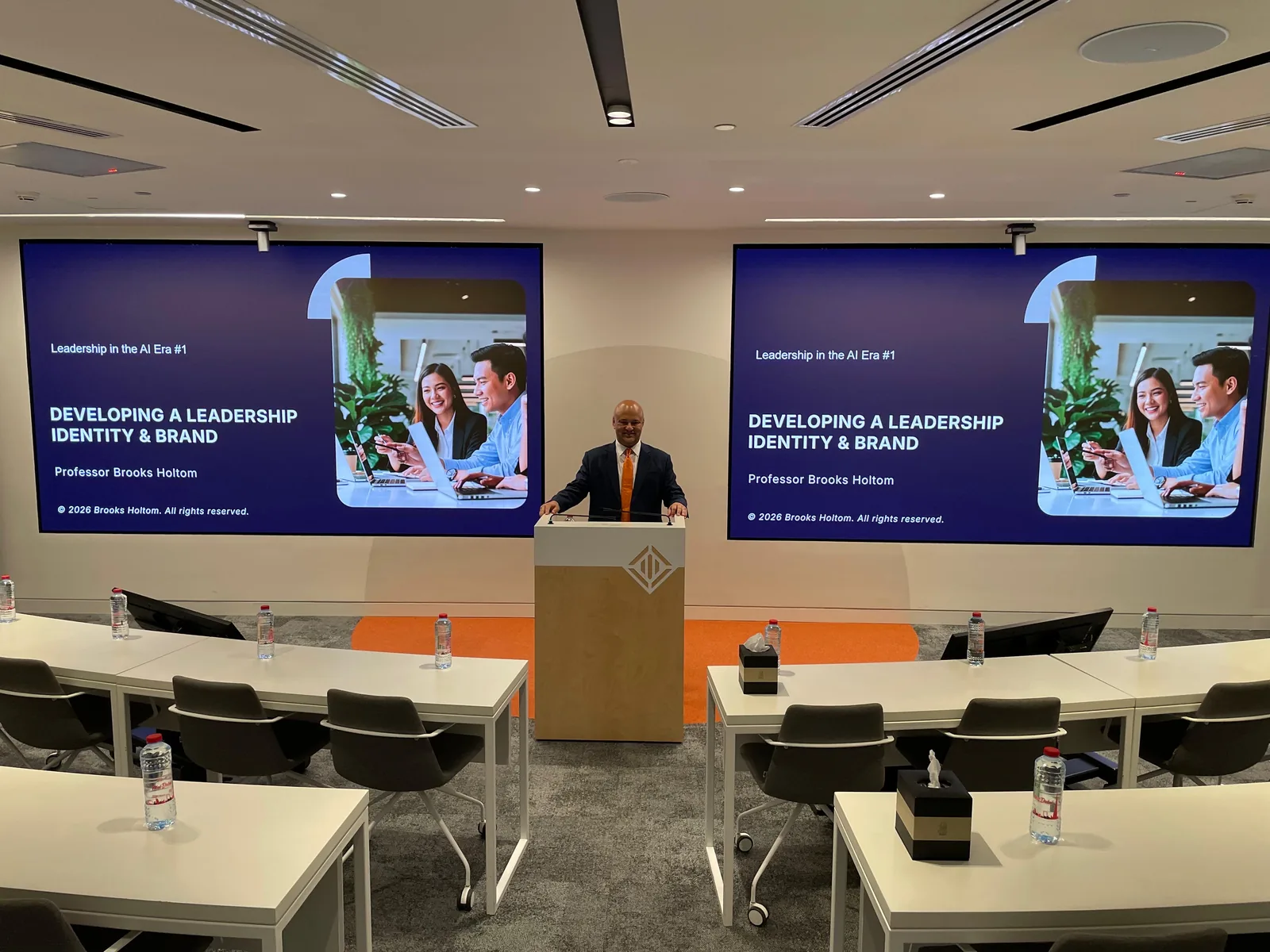
The Certified AI Officer program and the Advanced Leadership Series train both halves, at both altitudes, in the same language. They are built on the same core leadership concepts and AI application that Dr. Holtom, a Georgetown professor and one of our co-creators, teaches in his own Executive MBA program at Georgetown, a university whose government program is regularly ranked number one in the world and whose business school sits in the global top 20. And they are built to come into your organization next.
Leadership doubled. Train the whole job.
Dave Hajdu is the founder of Edge8 AI and the AI Officer Institute, where he trains the next generation of AI leaders across Southeast Asia and beyond.