AI Is Ready. Your Leaders Aren't
Your AI pilot didn't stall because the model was weak. Stanford found 77% of the hard work is data and workflows. That work needs a named, trained leader inside the company, and here is how founders find one.
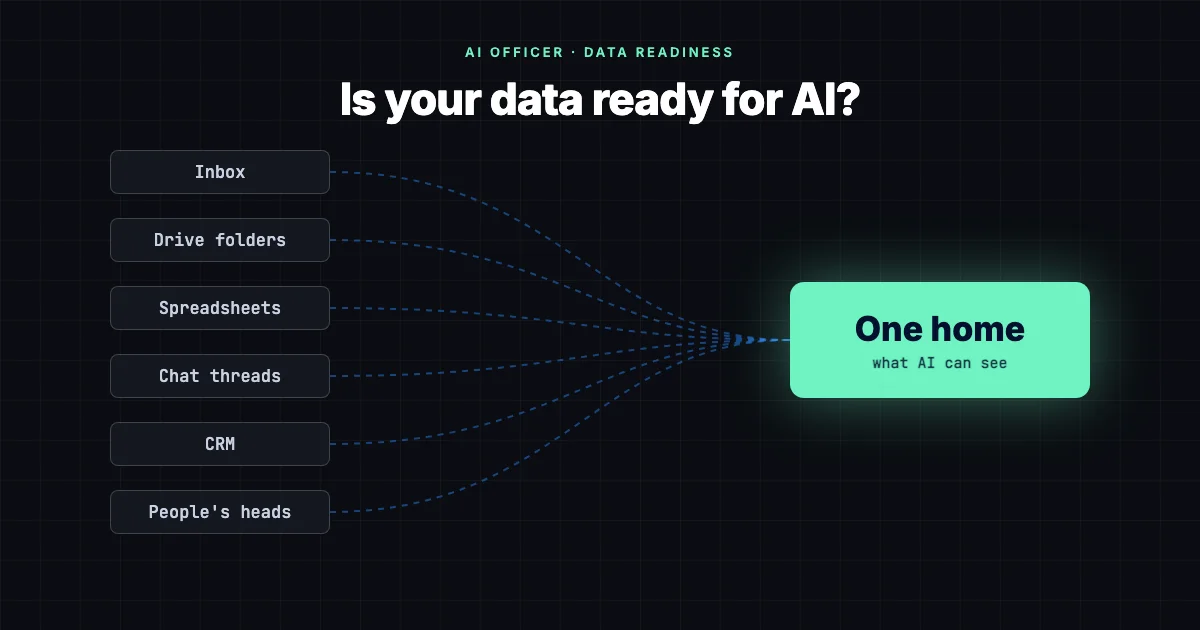
Is Your Data Ready for AI? It's a Leadership Call
Stanford found only 6% of companies had data ready for AI. Getting in is a leadership decision, not an IT project: one decision, one rule, one database, and it's the first thing an AI Officer owns.
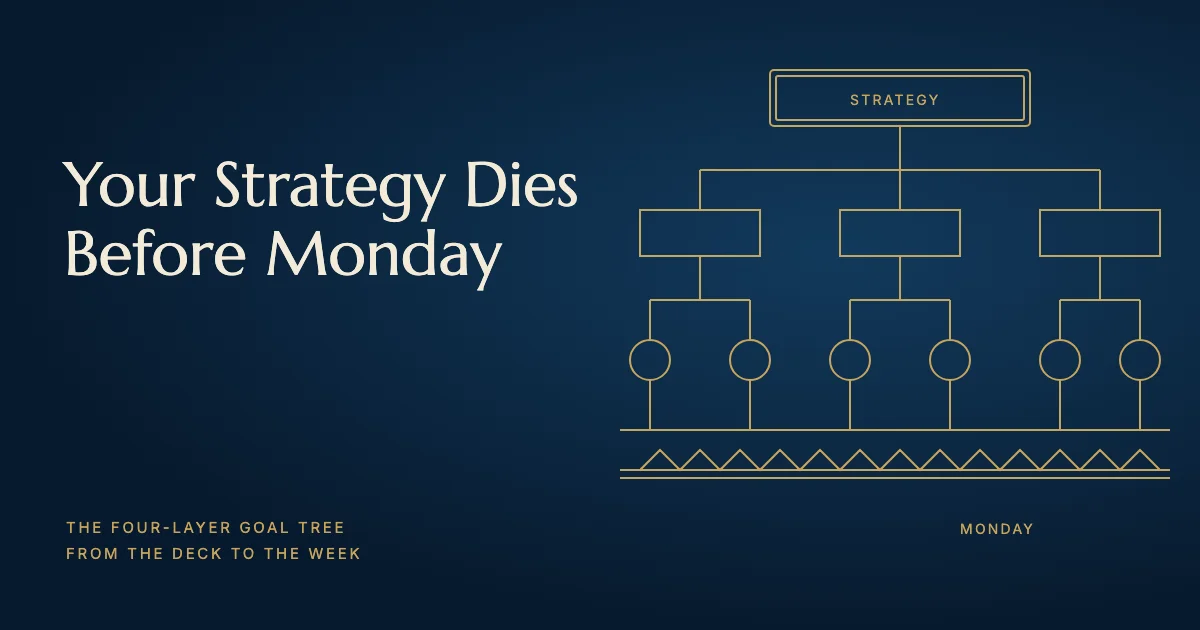
Your Strategy Dies Before Monday
Strategy fails between the deck and the calendar. A four-layer goal tree, one connection rule, and an AI that reads it every morning carry it to Monday. Translating it is the job of an AI-era leader.
The Eight-Week Path to One-on-Ones That Actually Happen
One-on-ones fail for three reasons: no prep, no accountability, no usable record. The eight-week path that uses AI to remove all three, our six-week scoreboard with the gaps included, and why founders should expect this from their leaders.
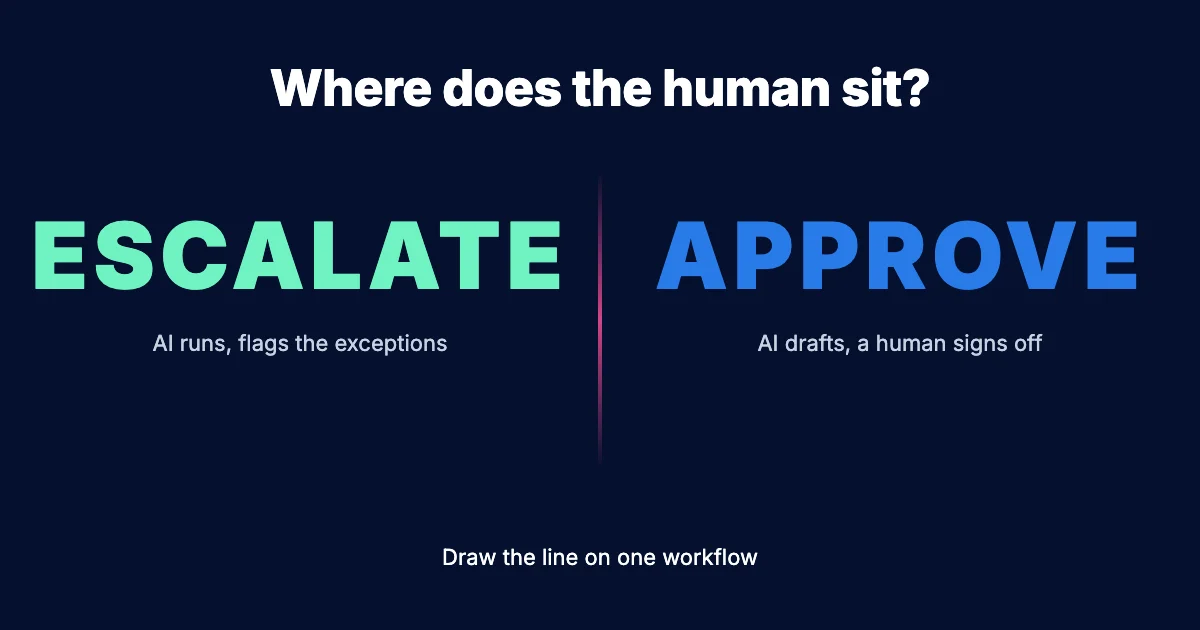
Escalate or Approve?
Approval puts the human at the gate; escalation puts them at the exception. Learn the workflow skill of deciding where the human sits, and practise it on one real workflow the way certification challenges test it.
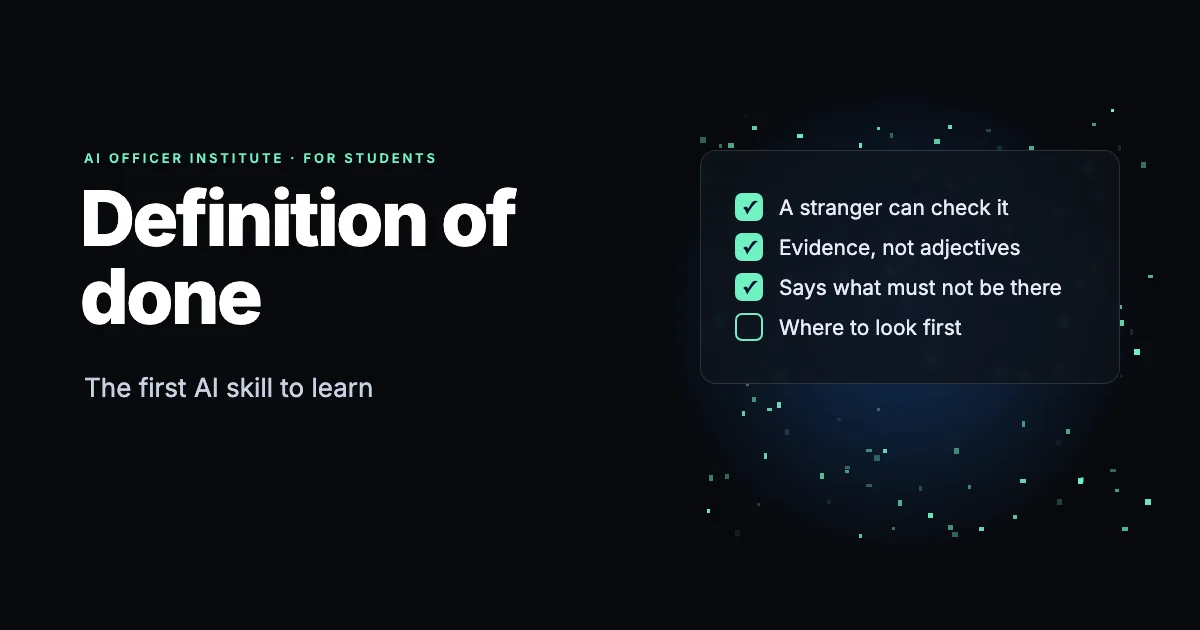
Definition of Done: The First AI Skill to Learn
AI declares itself finished at the most plausible point, not the right one. The first skill to learn: write a five-line definition of done before you hand work to a model. Weak vs strong examples, a reusable checklist, three tests.
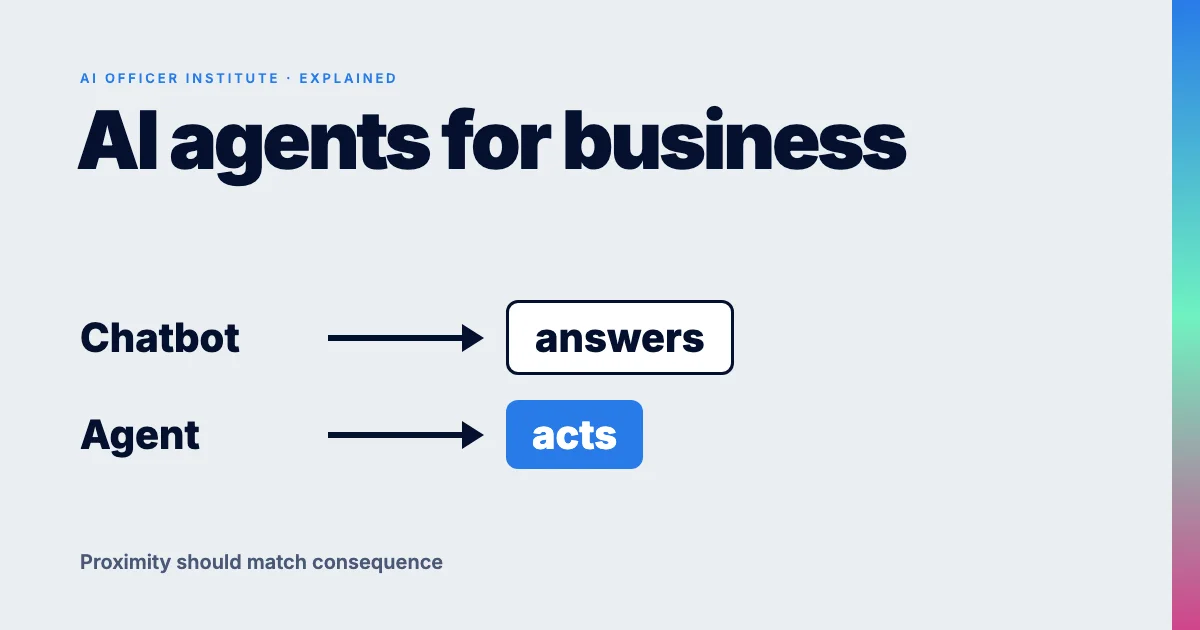
AI Agents for Business, Explained
A chatbot answers you. An agent does a job while you are somewhere else. A student's primer on what an AI agent needs to work, where it should run, and how to start building your first one.
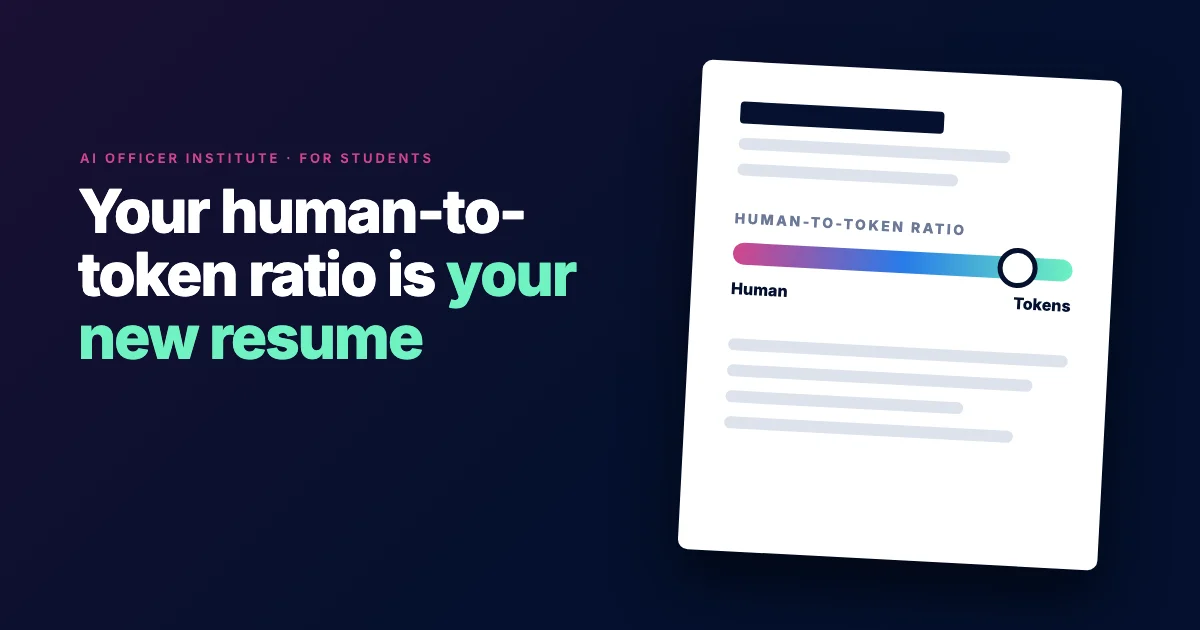
Your Human-to-Token Ratio Is Your New Resume
Your AI agents can build 19,000 tokens for every one you type. Why employers will judge you on the work you direct through AI, and how a student builds that leverage and proves it.
Your Prompts Are Expiring
Every model upgrade silently invalidates part of your prompt library, because a prompt is a workaround for a weakness the new models no longer have. Here is what actually compounds: model selection, problem framing, and planning.
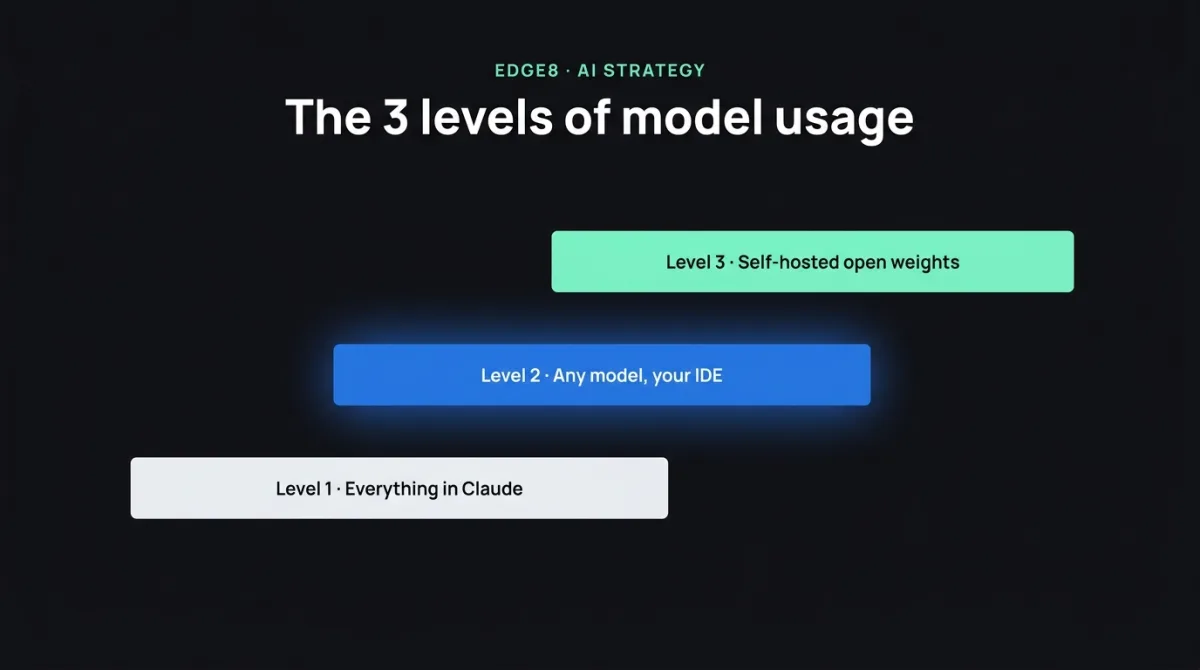
The 3 Levels of AI Model Usage
App, IDE, or self-hosted open-weight models? A leader's map of where to run AI, the real tradeoff at each level, and the three questions that tell you which one your company actually needs.
Your AI Isn't Failing. Your Tribal Knowledge Is Locked Up
Field data from nearly 300 business leaders in five cities: nearly all use AI, only 3 in 10 have a strategy, under 2% have AI-ready workflows. The blocker is tribal knowledge, and here is what has to exist before an agent is worth anything.
The CMS Is Dead. Claude Killed It
Non-technical founders can now control their content and ship like engineers. No WordPress, no plugins, no waiting on developers. The 4-step system that replaced the CMS.
The 18 Step Path to Infinite Leverage
Infinite leverage is a path you can walk, one protocol at a time. All 18 across five tracks: mindset, infrastructure, building, product management, and continuity.

The Other 50%, the Four Offices, and the Number That Proves It Worked
The three skills, the Four Offices, and infinite leverage in one operating model for leading a company where AI is on the team, plus how to measure that it worked.

AI Leadership Coach Assembly: Build Your Own with Claude Code
Do not build a coach, assemble one. Direct Claude Code to wire your datasets and frameworks into a system that preps every one-on-one, recaps every conversation, and mirrors how you coach.

Leadership Just Doubled. Most Programs Still Teach Half the Job
How to lead AI is now half of every leadership job. The two altitudes, the three tool-agnostic skills, and why prompt libraries fail. Train the whole job.

The Other 50% Requires Three Skills
Half of every workflow is now AI. Founders need three skills to lead it: cataloguing, workflow design, and code. The third is the one most leaders refuse to learn.

Leadership in the AI Era
An executive AI leadership program built by the AI Officer Institute with Dr Brooks Holtom of Georgetown University and David Nilssen. Three connected series, three working AI deliverables. 77 NPS in the Perth pilot.

Deep Work Is Dead. Long Live Multi-Delegation
How to delegate to AI without drowning: 45 minutes of compressed deep work, then agents running in parallel. The operating shift AI-ready leaders are quietly making.

I Interviewed Four Accountants Today. They're All Quitting Over AI
Four interviews, four industries, one story. Why AI-fluent employees are walking out — and the math that proves you can't afford the seat you won't approve.

Claude Routines Just Shipped. If Your Foundations Aren't Ready, It Doesn't Matter
Claude Routines is game-changing automation built into the AI layer. But for most companies, it will change nothing. Here's why the bottleneck is your workflow design, information architecture, and instruction writing - and how to fix it before the next release exposes you.

Prompts Are Dead
Prompt engineering is the wrong skill. The real competitive advantage is framework stacking - combining proven business frameworks with structured AI prompts.

The Four Offices of the Future: Why Your Org Chart Is the Reason AI Isn't Working
95% of companies see no AI ROI, not from bad technology, but failed leadership. Learn the four offices framework that connects AI to real business outcomes.

How to Build a Talent System That Actually Scales
Inside the Leadership in the AI Era program: how founders redesign hiring, retention, and leadership systems to build stronger teams using AI.

Iteration Is the Secret Weapon of AI Power Users
Anthropic's AI Fluency Index reveals the real secret of AI power users: iteration. What leaders should learn about human-AI collaboration.

Jack Dorsey Layoffs: What 4,000 Cuts Reveal About AI and SaaS
The real story behind Jack Dorsey's layoffs: AI-built internal tools are changing the economics of SaaS and company headcount.

8 Marketing Trends for 2026 That Actually Matter
The real marketing trends for 2026: AI agents, digital twins, autonomous marketing, and the systems companies must build to compete.

The Leadership Brand You Already Have (You Just Haven't Named It Yet)
Learn how leaders define their leadership brand under pressure. Insights from Dave Hajdu on building a leadership brandbook in the AI era.

Custom GPTs: How to Build Role-Based AI Assistants in ChatGPT
Learn how to build Custom GPTs in ChatGPT to create role-based AI assistants for research, writing, proposals, and team workflows.

7 AI Dictation Tools That Actually Work in 2026
Discover the best AI dictation tools in 2026 that turn speech into structured writing. A practical guide for professionals who want to write faster.

Google AI Studio and the Hidden Ecosystem That's Changing How AI Officers Work
Explore Google AI Studio and its hidden ecosystem including NotebookLM, Gems, Imagen and Opal. A practical guide for professionals using Google AI tools.

Interactive AI Avatars for Business: How to Scale Your Expertise with AI
Discover how interactive AI avatars help businesses scale expertise, automate training, and support sales without increasing headcount.

Google Labs Disco: Turn Browser Tabs Into AI-Powered Apps
Google Labs Disco uses Gemini AI to transform browser tabs into interactive apps called GenTabs, helping knowledge workers turn research into action.

Vibe Coding with AI: How No-Code AI Tools Let Anyone Build Software
Discover how Lovable enables non-technical professionals to build production-ready web applications in minutes with vibe-coding with AI. Transform your go-to-market speed.

10 Free AI Presentation Tools That Create Beautiful Slides in Minutes
Discover 10 free AI presentation tools that turn ideas into polished slides in minutes. Perfect for professionals, educators, and teams.

5 AI Trends for 2026 That Will Transform Your Career
The 5 biggest AI trends for 2026 including AI leaders, AI agents, data discipline, and centralized data systems.

AI Customer Service Personalization: A Framework That Drives Revenue
Discover the 3-layer AI personalization system transforming customer service, improving customer satisfaction, and increasing revenue.

AI Programs and Data Migration: The "Pizza Approach" to Start Faster
Learn how the "pizza approach" helps companies start AI programs faster by migrating only the data needed for specific business outcomes.

AI Psychosis and Mental Health: Risks and Responsible AI Design
What is AI psychosis? Explore the mental health risks of AI and how responsible AI design protects human wellbeing.

OpenAI Open-Weight Models: Learn AI by Running Models Locally
Learn how OpenAI open-weight models like gpt-oss-20b enable hands-on AI learning by running powerful models directly on your own hardware.

AI Personalization in Hospitality: How Hotels Use AI to Transform Guest Experiences
Discover how AI personalization helps hospitality brands increase guest satisfaction and revenue through data-driven guest experiences.