Many capable professionals have not used AI at work. Not once. They run teams, close deals, and sign off budgets, and they have never opened a chat tool for a real task. If that describes you, nothing in this post is a verdict. It is a map.
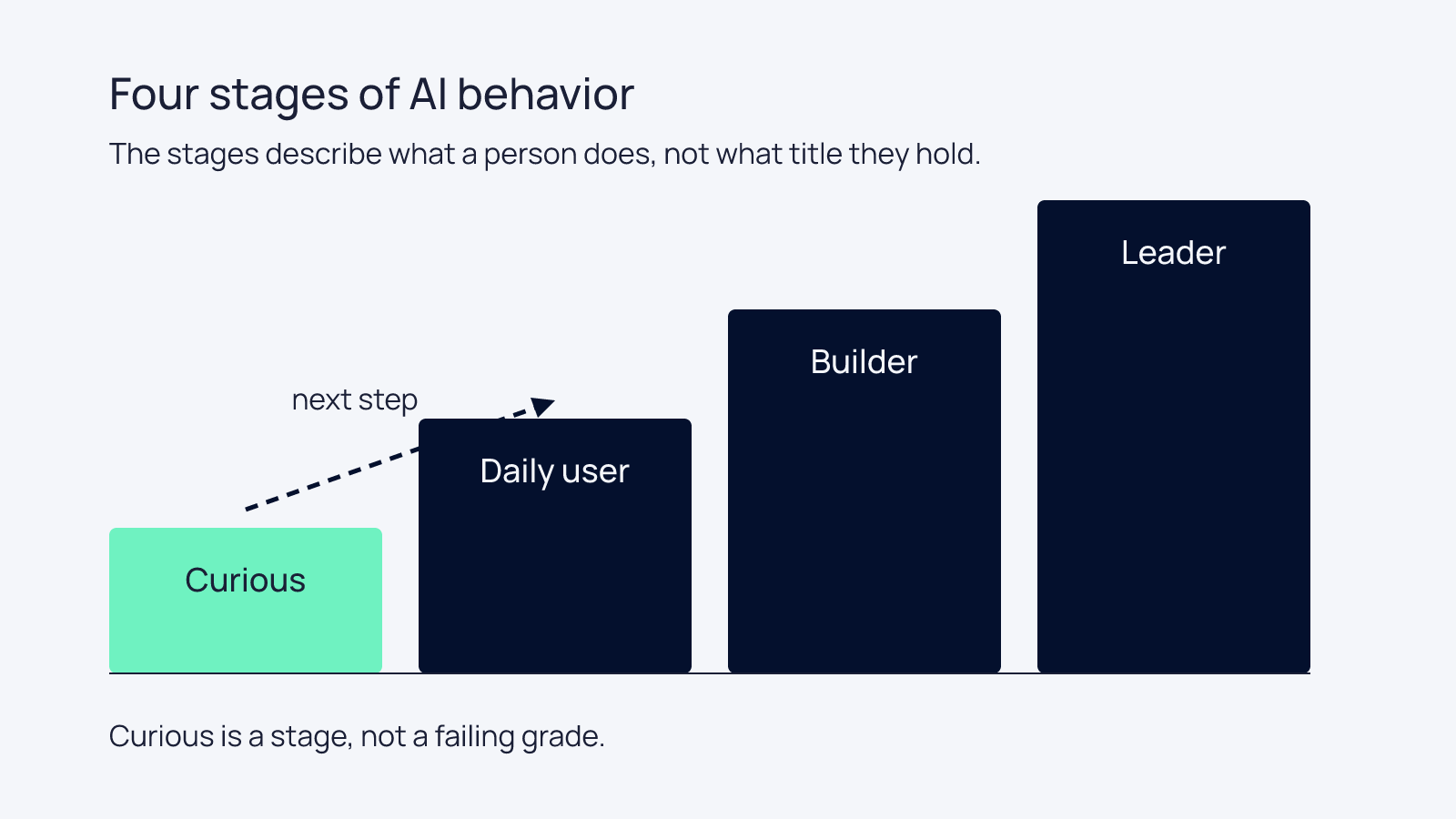
The AI Officer Institute sorts AI behavior into four stages: Curious, Daily user, Builder, Leader. The stages describe what a person does, not what title they hold. A managing director can be Curious. An analyst two years out of school can be a Builder. Where you sit on the map says nothing about your competence and everything about what you have tried so far.
The Institute measures progress through those stages the way it measures everything: by the work a person produces, not the hours they attend. That standard holds at stage one just as it holds at certification. Three common myths keep capable people stuck at Curious, and each one dissolves once you apply it.
- The Problem. Many capable professionals have never used AI for a real task at work, and the noise around adoption makes it feel as if the window has closed and avoiding the subject is the safest option.
- The Insight. Curious is the first of four behavior stages, not a verdict, and the way out is not a tools course but one real task judged against a standard you write down first: problem first, AI second, ROI always.
- The Way Forward. Pick one small task you already do well, write one line on the problem and one on a good answer, ask an AI chat tool, and compare. Then request access at aiolabz.com and start with the first lesson.
Myth one: if you have not started, you are behind
Many capable professionals have not started. They are cautious, short on time, or waiting for a reason.
Colleagues mention prompts in meetings. Vendors promise transformation. Somewhere a board paper asks about AI adoption. It is easy to conclude that the window has closed and that quietly avoiding the subject is the safest option.
Reality: Curious is a stage, not a failing grade. People stay there for ordinary reasons. They are cautious about data and reputation. They are short on time. They are waiting for a reason that is worth the effort. None of those is a character flaw, and none is permanent.
The stage model is useful precisely because it has a next step. The question is not "how far behind am I?" The question is "what single action moves me from Curious to Daily user?"
Myth two: the way to start is a course on the tools
The way out of Curious is not a course on tools.
When something feels unfamiliar, the instinct is to study it first. Enroll in something. Learn the features. Collect a certificate of completion, then begin.
Reality: the way out of Curious is one real task, not a syllabus. A tools course teaches you what a system can do in general. It does not teach you what it does with your work, on your problems, against your standard of good. Those are the only things that matter on Monday morning.
The same logic governs credentials. Attendance proves you were in the room. Work proves you can do the thing. What makes a certification serious is also what makes your first ten minutes with an AI tool useful: produce something, then judge it.
Myth three: daily users know what they are doing
It is tempting to assume that everyone already using AI has worked out a method, and that you would be joining a group that is ahead of you.
Reality: most daily users never built one. They ask, they get an answer, they paste it somewhere. They never wrote down what a good answer looks like before they asked, so they cannot tell a strong output from a plausible one. They are at stage two, but they arrived without a standard.
You can skip that trap entirely. Done properly, your first task gives you a method before it gives you a habit.
The one task that moves you to Daily user
That one comparison moves you to Daily user with a method from day one, which most daily users never have.
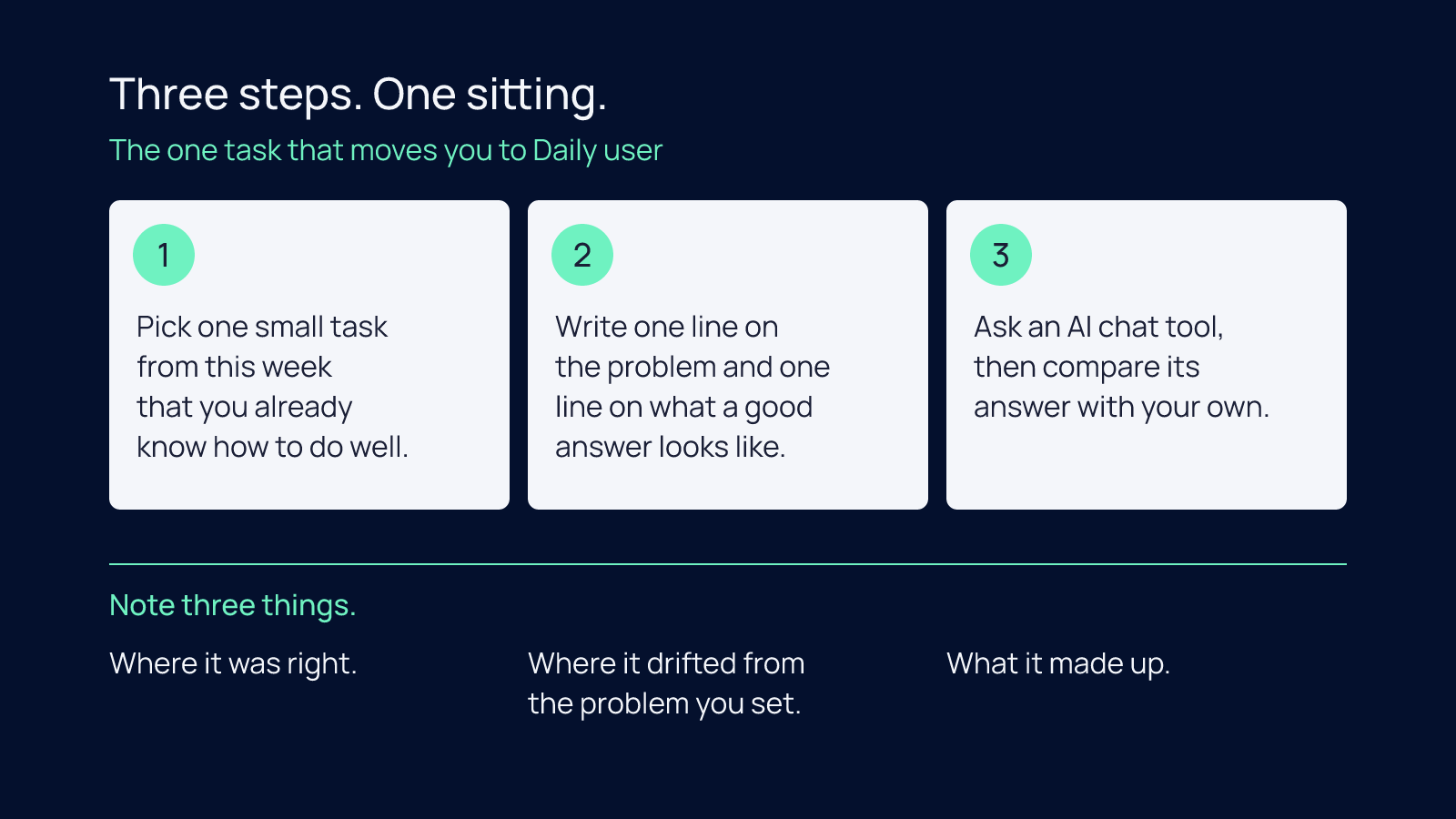
Three steps. One sitting.
1. Pick one small task from this week that you already know how to do well. A summary of a report. A reply to a difficult email. A first draft of a short note. Choose something you can already judge, because your judgment is the whole point of the exercise.
2. Write one line on the problem and one line on what a good answer looks like. For example: "Summarize this proposal for a CFO who has four minutes." Then: "A good answer names the cost, the risk, and the decision needed." Two sentences, written before you open the tool.
3. Ask an AI chat tool, then compare its answer with your own. Note three things. Where it was right. Where it drifted from the problem you set. What it made up. Be specific, and write the notes down.
That comparison is the whole lesson. You now know, from your own evidence, where the tool helps, where it wanders, and where it invents. You have a standard on paper and a result measured against it. That is a method, and you built it on day one. Most people who use AI every day never have.
Problem first. AI second. ROI always.
The order of those steps is not incidental. It is the principle the Institute teaches at every stage.
Problem first: you began with a task you understood and a definition of good. AI second: the tool entered only after the problem was framed. ROI always: the comparison told you whether the output was worth anything, and what it would have cost you to trust it unchecked.
Reverse the order and you get the pattern that fails inside organizations: start with the tool, then go looking for something to use it on. That is how companies end up with licenses and no results. One small task, done in the right order, protects you from it from the beginning.
From one task to a credential that means something
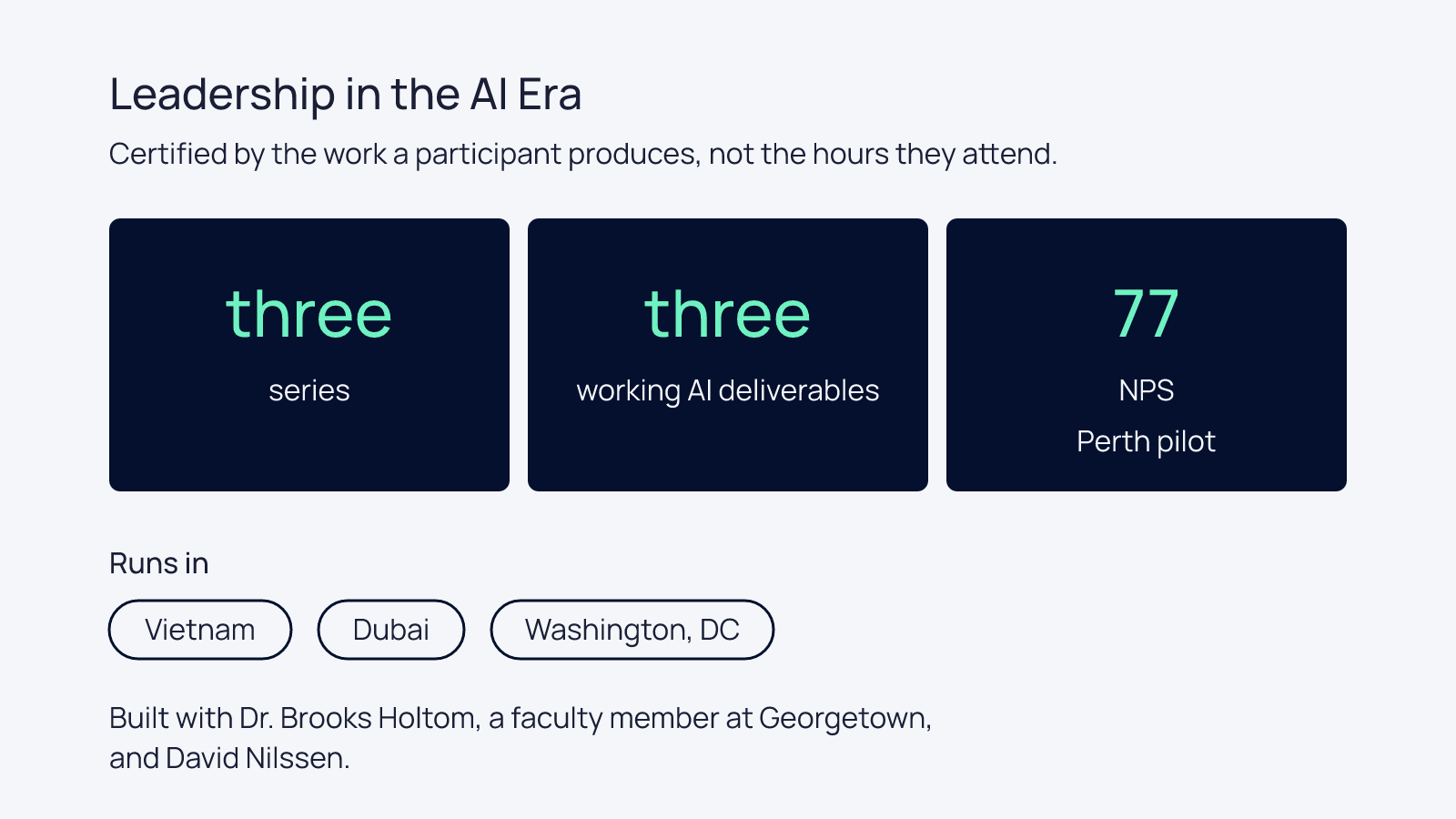
The stages do not stop at Daily user. Builder and Leader follow, and the Institute certifies progress through them by the work a participant produces, not the hours they attend. The flagship program, Leadership in the AI Era, was built with Dr. Brooks Holtom, a faculty member at Georgetown, and David Nilssen. Across three series, participants build three working AI deliverables. The Perth pilot scored a 77 NPS, and the program now runs in Vietnam, Dubai, and Washington, DC.
Every one of those participants started somewhere. Many started at Curious.
Your next step is smaller than a program. Request access at aiolabz.com and start with the first lesson. It walks you through the task above using your own work, so you leave with a method rather than a feature list. When you are ready to prove more than that, explore the certification and how you earn it.