Most professionals now open a chat tool every day. The results are hit or miss. One answer is sharp enough to send. The next is confident filler. The usual response is to blame the tool, or to blame the prompt and go looking for a better one.
Neither is the gap. The gap is method. Daily use is a habit. Skill is a method you can repeat and check.
That distinction is the same one the AI Officer Institute applies to every credential it issues. A certificate should prove capability, not attendance. You pass by producing work, not by showing up. The standard holds at the scale of a single afternoon with a chat window: opening the tool is attendance. Producing a result you can defend is proof.
What follows closes the gap in two parts: a four-stage map so you can name where you stand, and a three-move practice that takes a daily user toward a builder. Neither asks you to learn a new tool. Both ask you to change the order in which you work.
- The Problem. Most professionals open a chat tool every day and get inconsistent results: one answer is sharp, the next is confident filler. Blaming the tool or the prompt points at the wrong fix.
- The Insight. The gap is method, not tooling. Daily use is a habit; skill is a sequence you can repeat and check, and the move from daily user to builder is a change of order rather than a better sentence.
- The Way Forward. Pick one task you already hand to AI, write one line on the problem and one on what done looks like before you ask, then check the output against that line. That is the same standard the AI Officer Institute applies to certification: you pass by producing work, not by showing up.
Why daily use produces inconsistent results
Daily use is a habit; skill is a method you can repeat and check.
A habit is triggered by context: a blank page, a deadline, a question you cannot answer from memory. You type what comes to mind. Sometimes that sentence happens to carry the problem, the constraints and the shape of a good answer, and the result is excellent. Sometimes it carries none of those, and the model fills the silence with something plausible. The quality swings because the input swings, and nothing in the habit catches the swing.
So the tool was not failing. It was answering the question it was asked. Blaming the prompt is closer to the truth, but it still points at the wrong fix. A better prompt is a better sentence. A method is a better sequence, and a sequence is something you can repeat on Monday, hand to a colleague on Tuesday and check on Friday.
Name where you stand
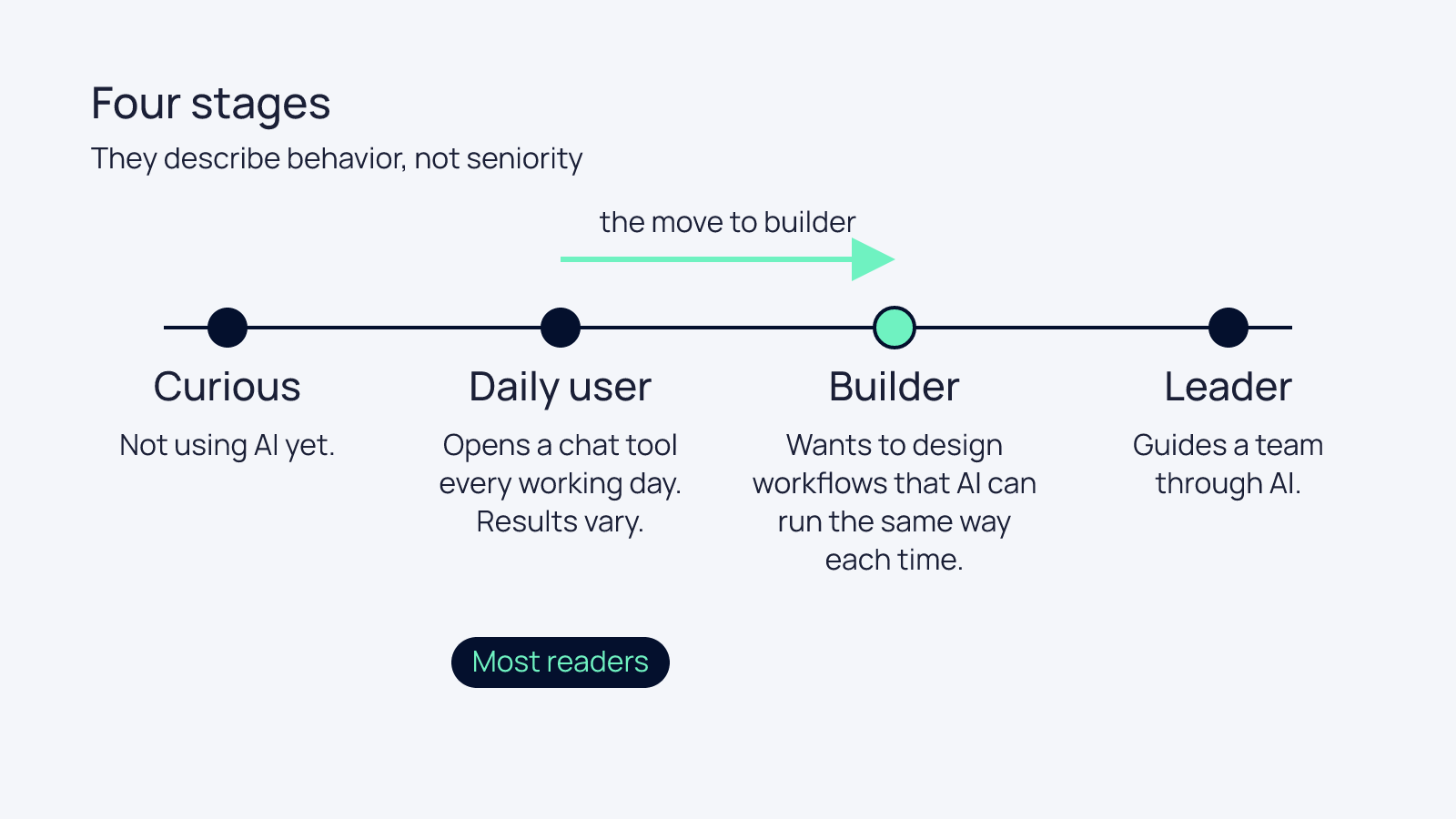
The Institute uses four stages. The labels are plain on purpose. They describe behavior, not seniority, and a managing director and a first-year analyst can sit at the same stage.
Curious. Not using AI yet. Reading about it, perhaps, and waiting for a reason.
Daily user. Opens a chat tool every working day. Results vary, and the variance is unexplained.
Builder. Wants to design workflows that AI can run the same way each time: a repeatable brief, a defined output, a check at the end.
Leader. Guides a team through AI. Sets the standard for what counts as a trustworthy output and holds people to it.
Most readers of this article are daily users. That is not a criticism. It is the largest stage, and it is the one with the most leverage, because the move to builder does not require code, a budget or permission. It requires a change of order.
What moves a daily user to a builder
What moves someone from daily user to builder is not a better prompt. It is starting from the problem, writing what a good answer looks like before asking, and checking the output before trusting it.
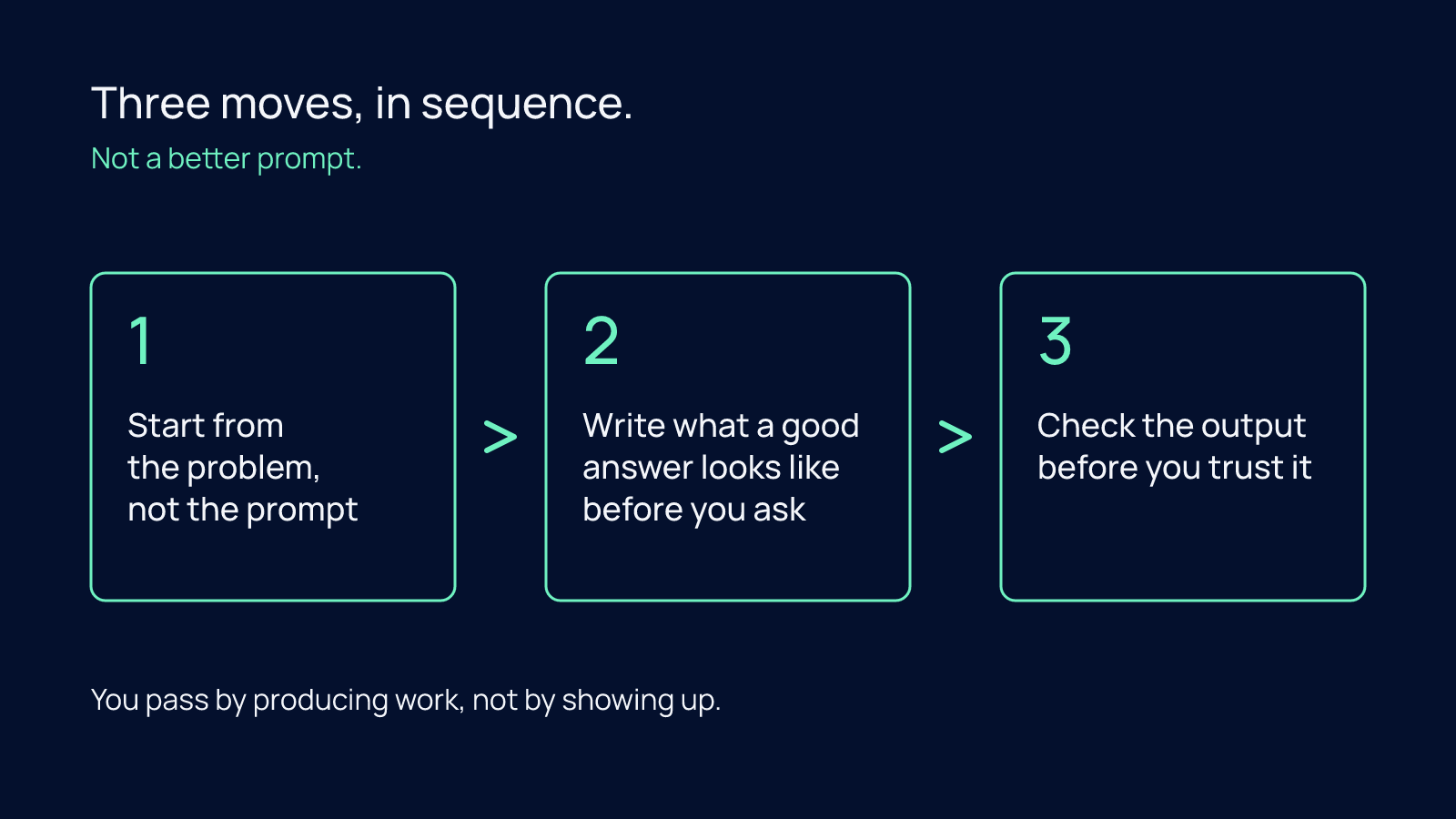
Not a better prompt. Three moves, in sequence.
1. Start from the problem, not the prompt
A daily user starts with the tool open and asks, "what should I type?" A builder starts with the tool closed and asks, "what am I actually trying to resolve, and for whom?" Writing the problem down in one line is the whole move. It forces you to decide what the task is before you delegate it. Delegation without a defined problem is how confident filler gets produced, by people and by models alike.
2. Write what a good answer looks like before you ask
This is the step daily users skip, and it is the one that explains most of the variance. Before the request goes in, write one line on what done looks like: the format, the length, the audience, the one thing it must include and the one thing it must not. If you cannot describe a good answer, you cannot recognize one, and you will accept whatever arrives with enough confidence.
A useful test: could a capable colleague do the task from your two lines alone? If not, the model cannot either. It will simply be less honest about guessing.
3. Check the output before you trust it
The third move turns a result into proof. Compare what came back against the line you wrote in step two. Did it meet the definition of done? Where did it drift? What did it assert that you did not supply and cannot verify? The check takes a minute, and it is the only part of the process that tells you whether the method is working. Skip it and you are back to the habit, with better paperwork.
The principle underneath
Problem first. AI second. ROI always.
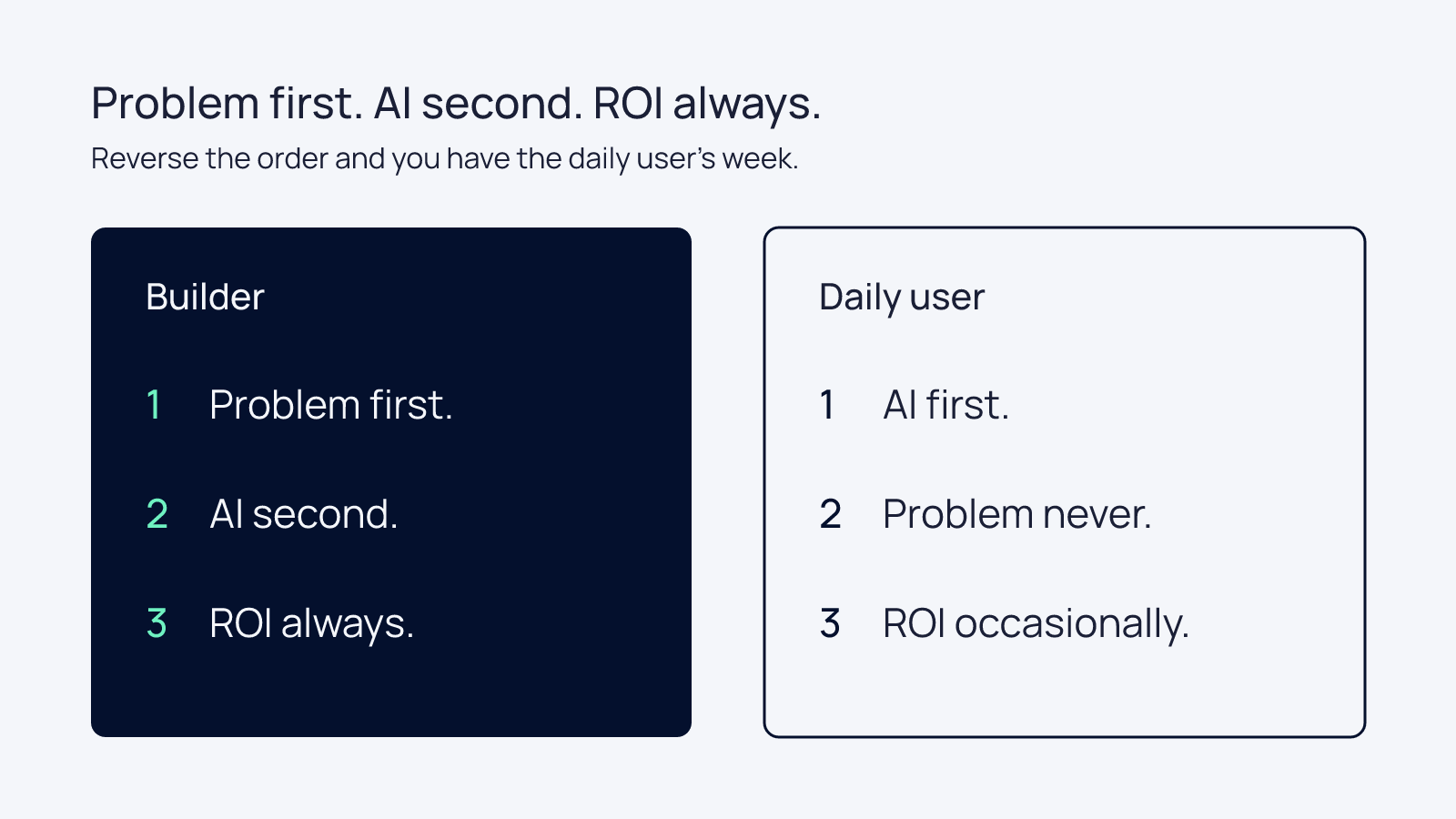
Problem first. AI second. ROI always.
Every move above follows from that order. Problem first means the tool waits until the task is defined. AI second means the model is the instrument, not the author of the question. ROI always means the check at the end is not optional, because an output nobody verified has no measurable value, however impressive it looked on screen.
Reverse the order and you have the daily user's week. AI first, so the outputs are sometimes right. Problem never, so the outputs cannot be judged. ROI occasionally, so the habit feels productive and the record shows nothing.
Try it this week
The practice fits inside work you are already doing, which is why it holds.
- Pick one task you already hand to AI: a summary, a first draft, a set of options, a reply.
- Before you ask, write two lines. One on the problem. One on what done looks like.
- Make the request as you normally would, with those two lines in front of it.
- Compare the result with the way you usually do it. Not whether it was faster. Whether it was closer to done, and whether you could say why.
One task, one week, two lines. If the result is better, you have the beginning of a method. If it is not, you have learned something precise about the task, which the habit would never have told you.
The standard behind the method
This framework is a small version of how the AI Officer Institute certifies leaders. The Leadership in the AI Era program, built with Dr. Brooks Holtom, who serves on the faculty at Georgetown, and David Nilssen, runs across three series, and participants complete it by producing three working AI deliverables. Nobody passes for attending. The pilot cohort in Perth scored a 77 NPS, and the program now runs in Vietnam, Dubai and Washington, DC.
The reason to mention it here is not the credential. It is the standard. A deliverable that works is checkable. A seat in a room is not. The same is true of a Tuesday afternoon with a chat window.
If you use AI every day and want a method rather than a habit, request access at aiolabz.com and start with the first lesson: the practice above, done with a check at the end. Then explore the certification and how you earn it.