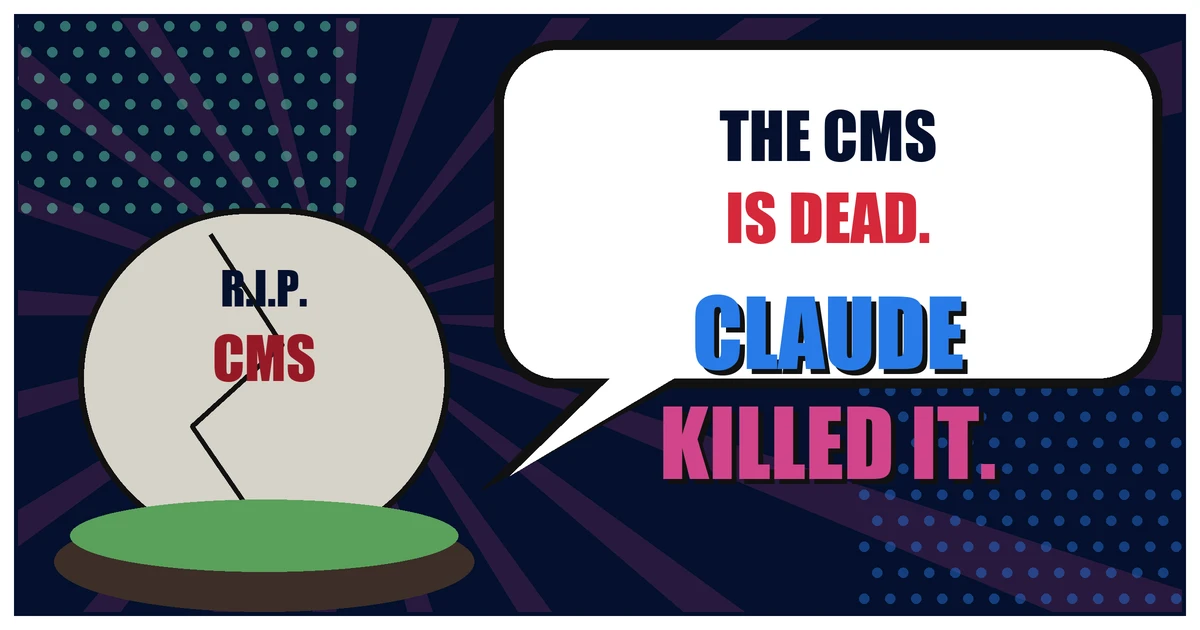
Non-technical founders can now control their content and ship like engineers. No WordPress. No plugins. No waiting on developers.
My first business after leaving Microsoft was a CMS for nightclubs and restaurants. The problem was simple: owners needed to update their sites constantly but were paying developers a fortune to change an event listing. So I built a system to let them do it themselves. It worked. But every CMS since has fought the same war, ease of use versus design freedom. AI just ended that war.
The Problem Every CMS Shares
WordPress, Squarespace, Wix, Webflow. They all started simple, then bloated into massive platforms trying to balance two things that fight each other: ease of use and design freedom.
Then Medium came along and said, we are just going to take design freedom away, you will probably mess it up anyway. They were not entirely wrong.
Framer lets you build beautiful sites fast. But at the end of the day it is still a CMS, still controlling what you can do through predefined templates, components, and content models.
Want five different blog layouts? Your CMS needs five templates. Want a different design for a how-to guide versus a thesis post versus a listicle? Your CMS just got exorbitantly big.
Every CMS makes the same tradeoff. AI eliminates the tradeoff entirely.
AI Is Not a Better CMS. It Is the Replacement
The shift is fundamental. A CMS stores your content in a database and renders it through a rigid template system. With AI, none of that matters. The AI stays in the same chat window. Generate the content, go into your web project, say: move this into the blog. It knows to update the index. It knows whether the post is featured. It handles the SEO, the GEO optimization, the image placement. All of it.
I can pick a style. I can point it to images organized in a specific folder. I can create any layout I want for any post, every single time. Full control without ever needing an engineer. This post, and its image, were built that way, no template, no plugin, no ticket to a developer.
The 4-Step System That Replaced the CMS
Built using organized projects and three tools any non-technical founder can set up in an afternoon.
- 01. Content in markdown. Content lives as .md files in organized folders, not in a database. The file system is the database: portable, version-controlled, readable by any tool. Always Be Cataloguing, that is the new ABC. See how we lay out folders for agentic development.
- 02. AI generates pages. A separate project handles the website. AI translates content into pages, React, HTML, whatever architecture you want. Static pages load faster, full stop. No weird dynamic URLs, no SEO redirect chains.
- 03. Push to GitHub. GitHub used to be reserved for engineers. Not anymore. Claude generates the terminal commands, you copy, paste, and run. Operate like a power engineer without knowing Git internals. Full protocol here: GitHub hygiene, check-in and check-out.
- 04. Deploy with Vercel. Vercel connects to your GitHub repository and deploys automatically on every push. Setup takes minutes, Claude walks you through the entire configuration. A production website that deploys on every commit, zero DevOps knowledge required. See Vercel hygiene, domains and DNS.
A Note on Databases
Am I saying databases are dead? No. I am a database guy at the core. But they do not need to be overused the way CMS platforms have been using them.
Transactional data, user accounts, analytics: not blog posts. A file system with well-organized markdown is simpler, more portable, and more AI-friendly for content workflows. Your AI can read, write, and organize markdown files natively. It cannot do the same with a WordPress database. Databases are not going away, they are just being overused. The right tool for the right job. When you do need one, that is where Supabase data structure basics come in.
What Changes
If you have ever been frustrated by your website, this is the unlock. You do not need to learn to code. You do not need to hire a developer for every content change. You do not need to wrestle with a CMS that was built for a different era. The tools are here right now: Claude, GitHub, Vercel, organized folders. That is the entire stack.
The barrier was never technical. It was the assumption that you needed someone technical to do this for you. That assumption is now wrong. Semi-technical or non-technical founders can control their content and ship like engineers. Today, not next year, not when the tools get better. Right now.
When AI is the CMS, you are not limited to what a platform allows. You are limited only by what you can describe. And describing things, it turns out, is something founders are very good at.
Ready to Build Without a CMS?
The AI Officer Institute teaches founders and executives how to build and operate AI-native systems from scratch, not theory, the actual stack, the actual workflows. The same ones running this website right now. This is protocol one of eighteen: read the full path in the 18 step path to infinite leverage, or start with the protocol itself, CMS is dead, AI is the CMS.
The CMS era is over for anyone willing to move. Learn more about the AI Officer certification program and join the operators building on what actually works. The organizational lens for where this shift belongs in your business is the Four Offices of the Future, the Operations office is exactly where your CMS replacement lives.