Three always-on agents reached the market within months of each other: xAI's Grok Bot, OpenAI's Dots, and Anthropic's Claude Duet. In most leadership meetings the first question is the same. What does a seat cost?
It is a fair question and a small one. Price is the smallest decision you will make about an agent. The decision that determines whether the agent is useful, and whether it is safe, is how it reaches your company's data. Get that right and the vendor becomes a seat you can swap. Get it wrong and no price is low enough.
- The Problem. Grok Bot, Dots and Claude Duet arrived within months of each other, and most leadership meetings open by comparing seat prices. That comparison takes a minute and says nothing about whether the agent is useful or safe.
- The Insight. All three see an inbox and a calendar out of the box, none can see the business, and every vendor leaves the path to your central database for you to build. The decision that matters is one secured door onto that database, governed by a default-deny role, column redaction, human-approved writes, named identity and a full log with one off switch.
- The Way Forward. Build the door once and any agent becomes a swappable seat, so take the five questions into the next vendor conversation and specify the door before buying seats. That specification is the kind of working deliverable the Leadership in the AI Era program certifies, with a 77 NPS from the Perth pilot and a pass earned by producing work, not by showing up.
The pricing in 60 seconds
Price is the smallest decision.
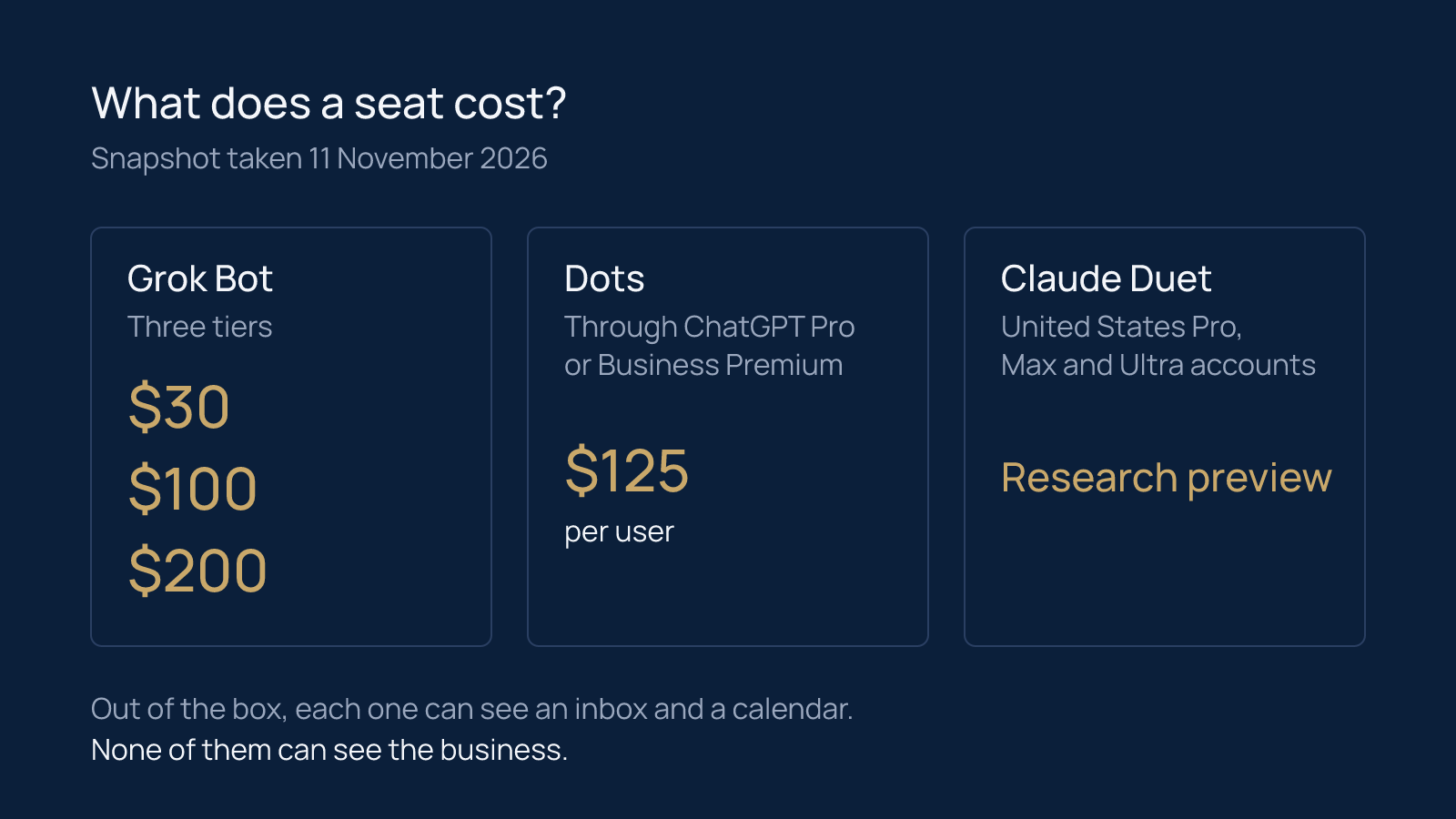
Snapshot taken 11 November 2026, so check before you quote it internally.
- Grok Bot is sold in three tiers: $30, $100 and $200.
- Dots comes through ChatGPT Pro or Business Premium at $125 per user.
- Claude Duet is in research preview, available to United States Pro, Max and Ultra accounts.
That is the whole comparison, and it took less than a minute. Notice what it did not tell you.
What all three share, and what none of them can see
Out of the box they see an inbox and a calendar, not the business.
All three arrive bundled with a chat subscription. All three share a usage pool with background work, so the agent running overnight draws from the same allowance as the person typing at nine in the morning. All three reach outside systems through connectors built on the Model Context Protocol, MCP, the open standard for plugging a model into tools.
Out of the box, each one can see an inbox and a calendar. None of them can see the business.
The customer records, the pipeline, the invoices, the project history, the things that make an assistant worth paying for, live in a central database the agent has no path to. Every vendor leaves that path for you to build. That is where the real decision sits, and it is the decision most buying committees skip.
Four ways teams get data access wrong
When a team wants the agent to be useful quickly, it reaches for one of four shortcuts. Each one trades a week of setup for an open-ended liability.
The master key. The agent is handed an administrator credential so it can answer anything. Fastest to configure, widest blast radius. One bad prompt, one injected instruction in an email it reads, and the agent can reach every table.
The shared login. One service account, used by everyone. The agent works, but nobody can say who asked for what. When a record changes, the log says the agent did it, which is the same as saying no one did.
The do-it-yourself connector. An engineer writes a quick MCP server against production so the agent can query it directly. No review, no redaction, no policy on writes. It ships because it works in the demo.
The open door. The database endpoint is exposed to the agent's network so it can just query things. This is the master key without the pretense of a key.
None of these is a vendor problem. Grok Bot, Dots and Duet are equally dangerous behind any of them, and equally safe behind the alternative.
The secure door: five rules
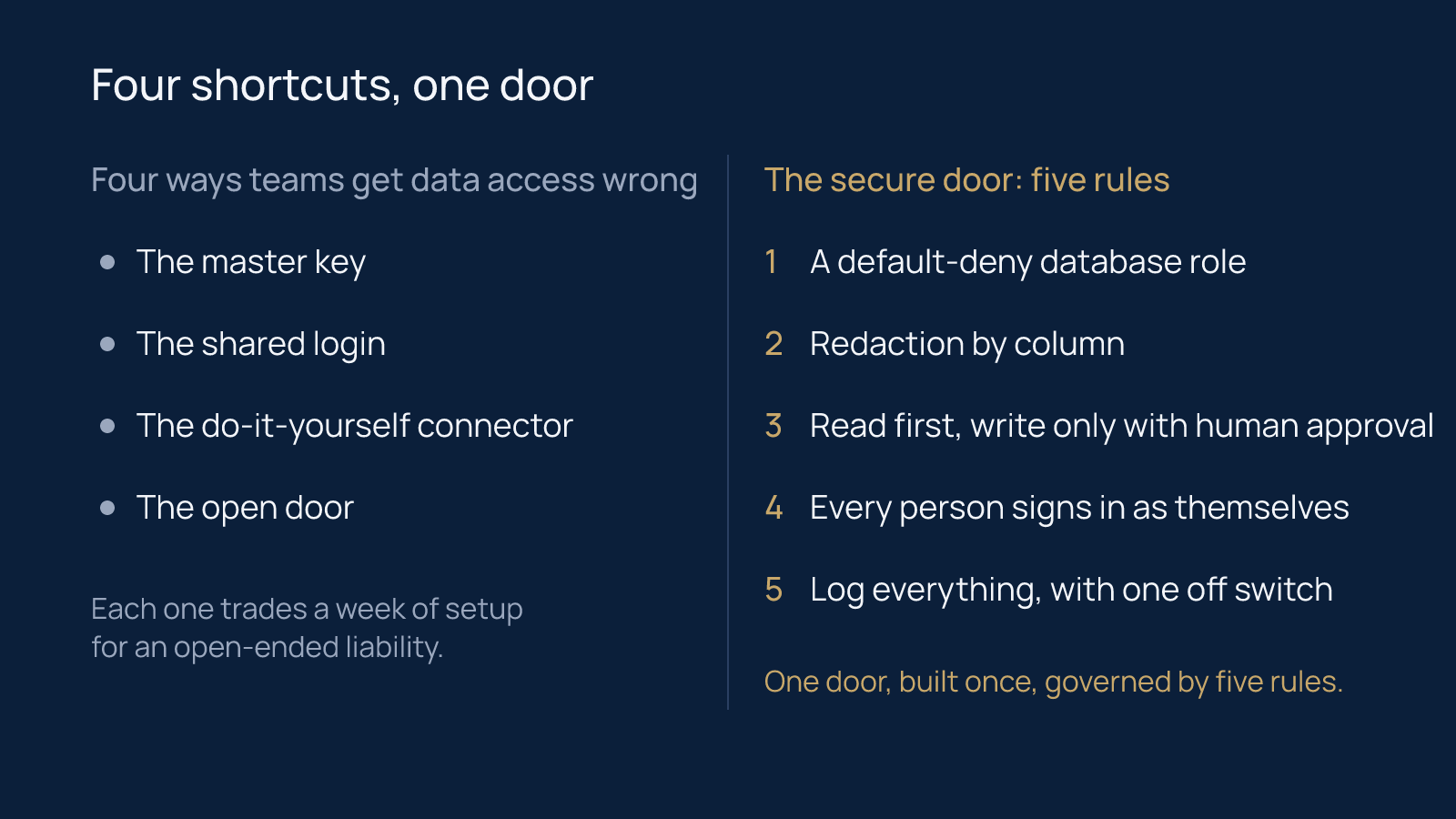
The alternative is one door, built once, governed by five rules.
- A default-deny database role. The agent signs in as a role that can see nothing until a human grants a specific table, view or query. Access is a list of permissions, not a list of exclusions.
- Redaction by column. Sensitive columns never leave the database. Salaries, personal identifiers, card details and anything a regulator cares about are masked or excluded at the role level, so the agent cannot be talked into revealing what it cannot read.
- Read first, write only with human approval. The agent proposes a change; a named person approves it. Reads can be broad within the role. Writes are gated every time until the organization has evidence to loosen the gate.
- Every person signs in as themselves. The agent acts on behalf of an identified user, with that user's permissions and that user's name on the record. No shared accounts, no anonymous actions.
- Log everything, with one off switch. Every query and every proposed write is recorded, and a single person can stop all agent access in one action. If you cannot turn it off in a minute, you do not control it.
These rules are not exotic. Most are the same controls a competent database administrator applies to a new employee. The difference is that leaders rarely ask for them when the new employee is software.
How Edge8 built on those rules
Edge8 built its own team assistant on exactly this pattern. The principle the team used is worth repeating because it fits on one line: the security boundary is the database. Not the prompt, not the model, not the vendor's trust and safety page. The database decides what the assistant can see and do, and everything else is interface.
One caveat, stated plainly: that assistant runs inside Edge8's portal, not behind an MCP server. The five rules are proven in production; packaging them as an MCP connector for Grok Bot, Dots or Duet is a separate piece of work. The rules do not change. The plumbing does.
One door, any agent
What decides whether an agent is useful, and safe, is one secured door onto the company's central database.
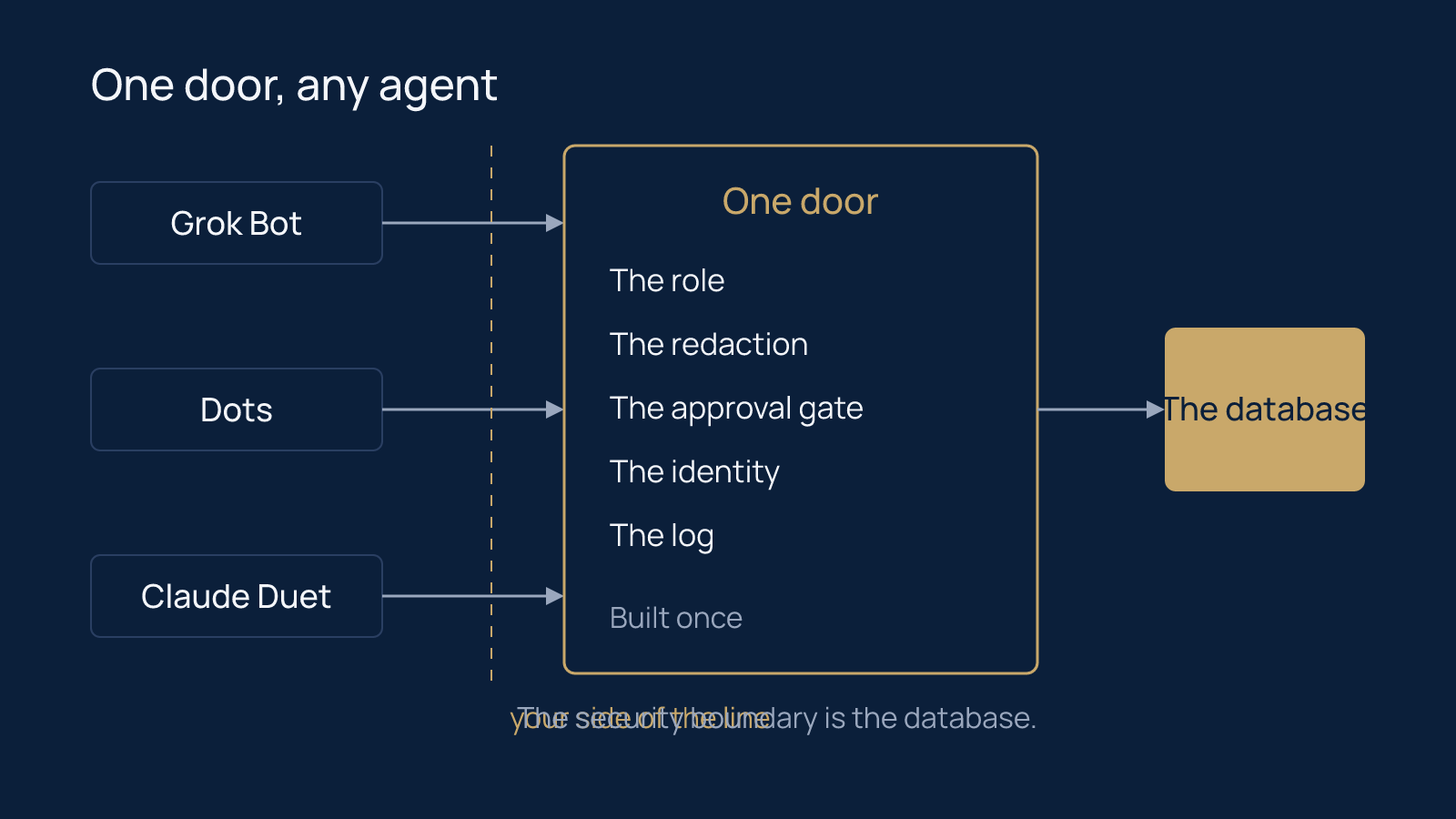
Once the door exists, the agent on the other side is interchangeable. Grok Bot connects to the same door as Dots. Duet connects to the same door as both. The role, the redaction, the approval gate, the identity and the log all live on your side of the line.
The vendor becomes a swappable seat, and the seat price becomes what it should have been from the start: a procurement detail. If one vendor doubles its price or changes its usage pool, you move. If one ships a model that is better at your work, you move. Nothing about your data posture changes.
That is the comparison worth making. Not which agent costs $30 or $125, but whether your organization has the one door that makes any of them safe to buy.
Five questions to ask before buying seats
Take these into the next vendor conversation and into the next conversation with your own technology lead.
- Which database role will the agent use, and what does it deny by default?
- Which columns never leave the database, and who decided that list?
- What can the agent write, and which named person approves each write?
- When the agent acts, whose name is on the log?
- Who can turn it off, and how long does that take?
If the answers are clear, buy the seats. If the answers are a shrug, the price does not matter yet.
The standard a leader is measured against
A leader equipped for the AI era is not the one who picked the right vendor. It is the one who can specify the door. That specification is the kind of working deliverable the Leadership in the AI Era program certifies.
The program runs as three series and produces three working AI deliverables. It was built with Dr. Brooks Holtom, faculty at Georgetown, and David Nilssen. The Perth pilot scored a 77 NPS, and the program now runs in Vietnam, Dubai and Washington, DC. You pass by producing work, not by showing up.