I asked an AI to clean up my computer. It found a framework I'd built to make me faster, and the most useful thing it did was help me delete it.
That sentence is the whole argument. But the details are where the lesson lives, and the details matter to anyone leading in the AI era. Because the standard we should hold ourselves to is not "did we adopt the tools?" It is "can we still see clearly what the tools are doing?"
- The Problem. The tools we install for leverage quietly become the thing we have to maintain. A routine cleanup found a homegrown agent framework woven into every project: stale docs, dead references, telemetry phoning home.
- The Insight. Adoption cost is visible and small. Exit cost stays hidden until you pay it. Capability in the AI era is measured by what you can still see, control and remove.
- The Way Forward. Audit what your agent tooling installs, updates and transmits. Keep the tooling that earns its place, remove the scaffolding, and respect the guardrails you built even when they stop you.
The innocent start
The request was routine. Clean up my computer. Audit the CLAUDE.md files across roughly 25 repositories, tidy the documentation, remove the obvious cruft. This is the kind of housekeeping every serious builder puts off and every honest one eventually does.
What surfaced was not cruft. It was rot.
The rot surfaces
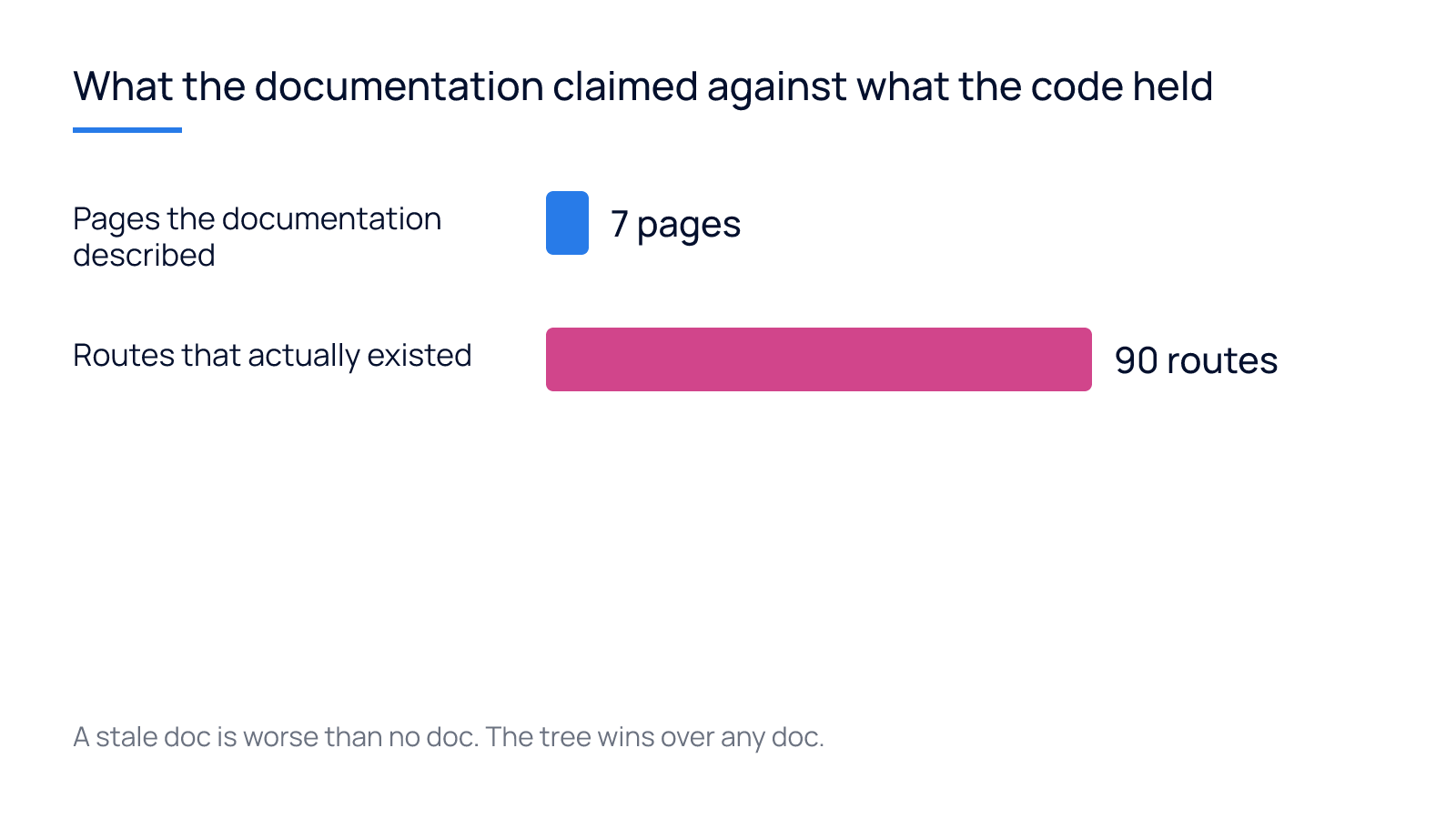
Documentation described 7 pages where 90 routes actually existed. Frameworks were documented that the projects no longer used. A reference file had been silently overwritten with a generic stub. The same boilerplate was wrong in every repository, because it had all descended from one template.
Here is the uncomfortable pattern. The documentation was not merely out of date. It was confidently, authoritatively wrong. A stale doc is worse than no doc. No doc makes you go look. A wrong doc lies to you with a straight face, and you act on the lie.
The tree wins over any doc. The code is the truth. Everything else is a claim about the truth, and claims decay.
The uncomfortable discovery
The wrong docs were a symptom. The cause was a framework I had built, and it was not just documentation. It was infrastructure.
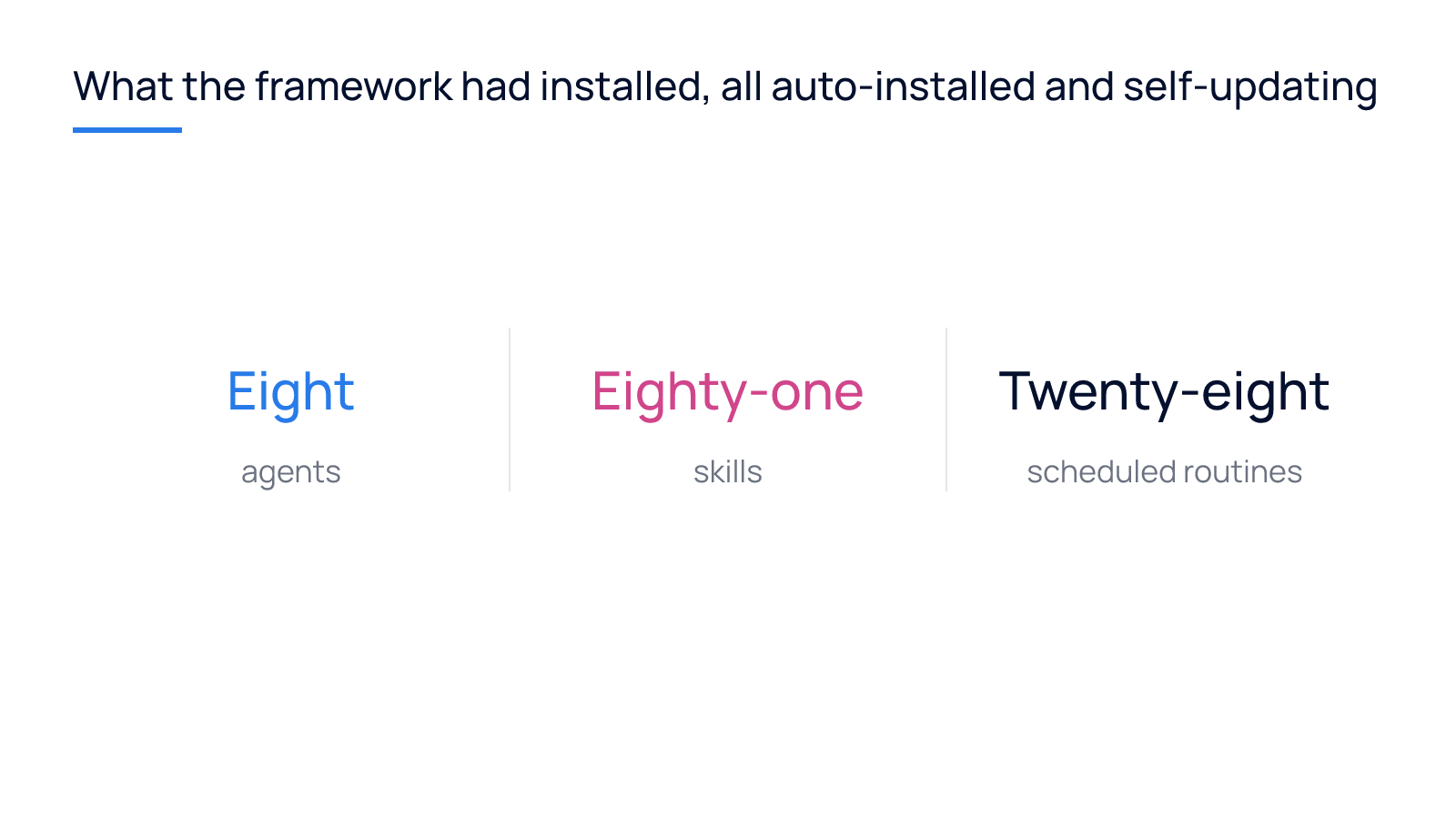
Hooks were capturing every session and shipping telemetry out through gh. Eight agents. Eighty-one skills. Twenty-eight scheduled routines. All auto-installed. All self-updating. All woven into every project I touched.
The scariest artifact was not the thing that was broken. It was the thing that was working. Telemetry I had forgotten I turned on, phoning home quietly, exactly as designed. Nothing had failed. That was the problem.
The decision
removal is a first-class engineering skill, not a failure
The instinct is to patch. Fix the docs, silence the telemetry, ship a new version of the framework. I chose to remove it instead. Permanent deletion of my own system.
This is the part that reads as failure and is actually the opposite. Removal is a first-class engineering skill. We celebrate the install. We rarely respect the excision. But a leader who cannot remove what no longer serves the work is not in control of the work.
The careful excision
The interesting part was removing it correctly.
The framework was not the same as the genuinely useful tooling. The Lark skills stayed. The project pipelines stayed. The QA guardrails stayed. Surgical deletion means distinguishing the scaffolding from the structure, and cutting only the scaffolding.
So, no git add .. No force-push. No --no-verify. Pull requests, not silent merges to production. And when one repository's own plan-protocol guard blocked me, I obeyed it rather than bypassing it.
That last point deserves weight. A guardrail I had built stopped me from doing the thing I intended to do. That is not an obstacle. That is the system working as designed. Guardrails you build should be able to stop you, including on the day you are certain you are right.
The inversion nobody prices in
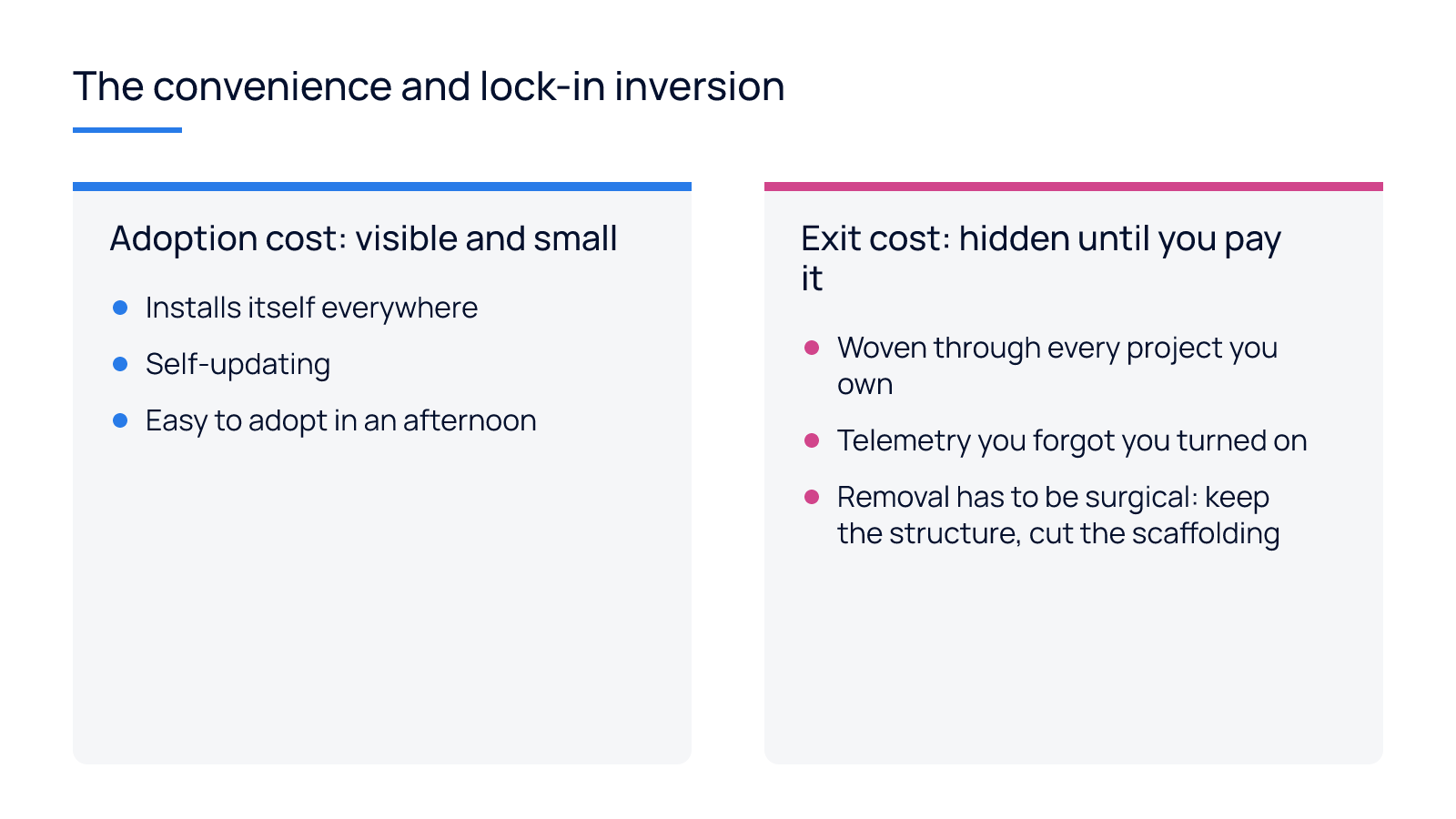
Here is the lesson leaders should carry out of this. A framework that installs itself everywhere is cheap to adopt and expensive to leave. Adoption cost is visible and small. Exit cost is hidden until you pay it, and by then it is woven through every project you own.
Everyone is racing to install agents, skills, hooks, and MCP servers. Almost nobody is measuring the exit cost. The convenience that makes a tool easy to adopt is the same property that makes it hard to remove.
The framework I deleted was called Infinite Leverage. I will own the irony. Real leverage sometimes means subtracting.
What this has to do with the standard
The frame is not "frameworks bad." Frameworks are fine. The frame is that capability in the AI era is not measured by what you have installed. It is measured by what you can still see, control, and remove.
This is why we certify leaders on the work they produce, not the sessions they attend. Attendance tells you someone was in the room. It tells you nothing about whether they can audit a system, distinguish scaffolding from structure, and make the hard subtraction. You prove that by doing it, not by watching a slide about it.
In the Leadership in the AI Era program, built with Dr. Brooks Holtom of Georgetown and David Nilssen, participants leave with three working AI deliverables, not a certificate of attendance. The Perth pilot scored a 77 NPS. The standard is the same one this story argues for: proof, produced.
If you want your leaders to be the kind who can build a system and also know when to kill it, the credential should test exactly that.
Explore the certification and how you earn it.