Six months of spend, and not a single number moved. That is the outcome I have watched founders and CTOs describe after building an AI plan that was really a shopping list: a tool for notes, a tool for support, a tool for sales, a tool nobody opens by March. The tools were fine. The thinking underneath them was missing. If you want to know how to build an AI roadmap that actually moves the business, the first correction is where you start. A column of logos with a budget beside each one is a wish list, and wish lists do not change results.
This is why most AI projects stall before they show ROI: the roadmap began in the tool aisle instead of the org chart. So here is a better starting point, and then a prompt to run it yourself.
- The Problem. Most AI roadmaps are a shopping list of tools with a budget beside each logo. Six months later nobody can point to a number that moved.
- The Insight. Start from the org chart, not the tool aisle: decide what humans do and what AI does, office by office. With AI, the leverage moved to planning.
- The Way Forward. Run the AI Buddy prompt: a guided session of about two hours that leaves you with a ranked roadmap, one workflow designed for AI to run, and a working prototype.
How to build an AI roadmap that starts with roles, not tools
A sound roadmap does not open with "which tools should we buy." It opens with an older question: what should humans do, and what should AI do?
That is a casting decision, not a software decision. You have always replaced lower performers with higher ones and chosen based on the work. AI is another performer on the roster, judged on output. See it that way and the order becomes obvious: first decide the roles, then hire the tools.
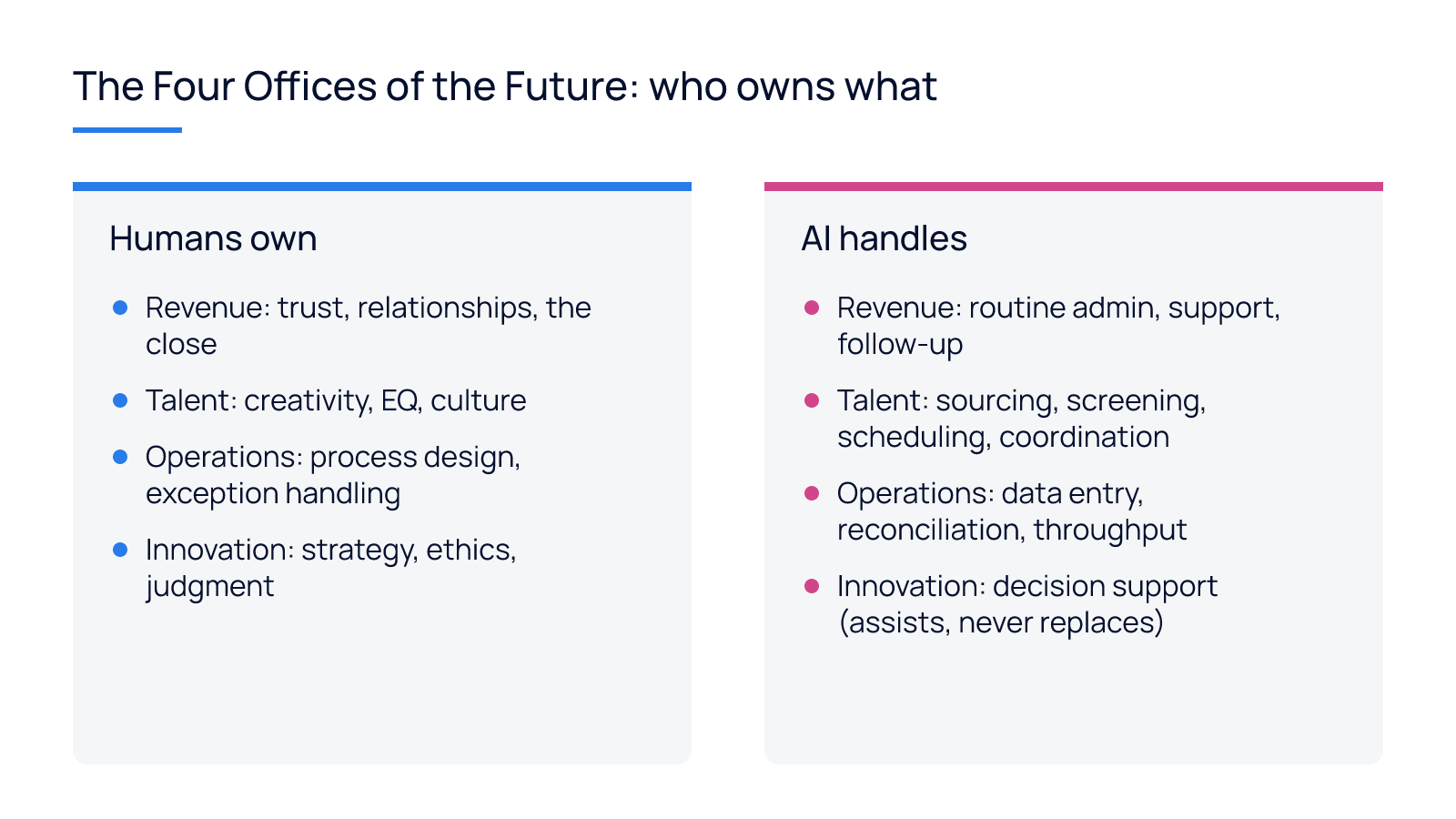
The frame we use at Edge8 for making that call is the Four Offices of the Future. Push routine admin, data entry, and support work onto AI, and the human organization collapses into four offices, each built around the work only humans do well.
| Office | Humans own | AI handles |
|---|---|---|
| Revenue | Trust, relationships, the close | Routine admin, support, follow-up |
| Talent | Creativity, EQ, culture | Sourcing, screening, scheduling, coordination |
| Operations | Process design, exception handling | Data entry, reconciliation, throughput |
| Innovation | Strategy, ethics, judgment | Decision support (assists, never replaces) |
Notice the pattern. In every office, humans keep judgment, trust, and creativity. AI takes the routine. That is the sorting rule, not a slogan. When you are unsure which side a task belongs on, ask whether it needs a human's trust or a human's judgment. If it does, keep it human and let AI assist. If it does not, hand it over. This is humans and AI working the same problem together, with a clear line down the middle.
Run every task through that filter and AI stops being a list of tools. It becomes a question about leverage: where does handing the routine to AI free a human to do the work only a human can. That is how to think about it. Here is how you begin.
The prompt: how you start today
with AI, the leverage moved to planning
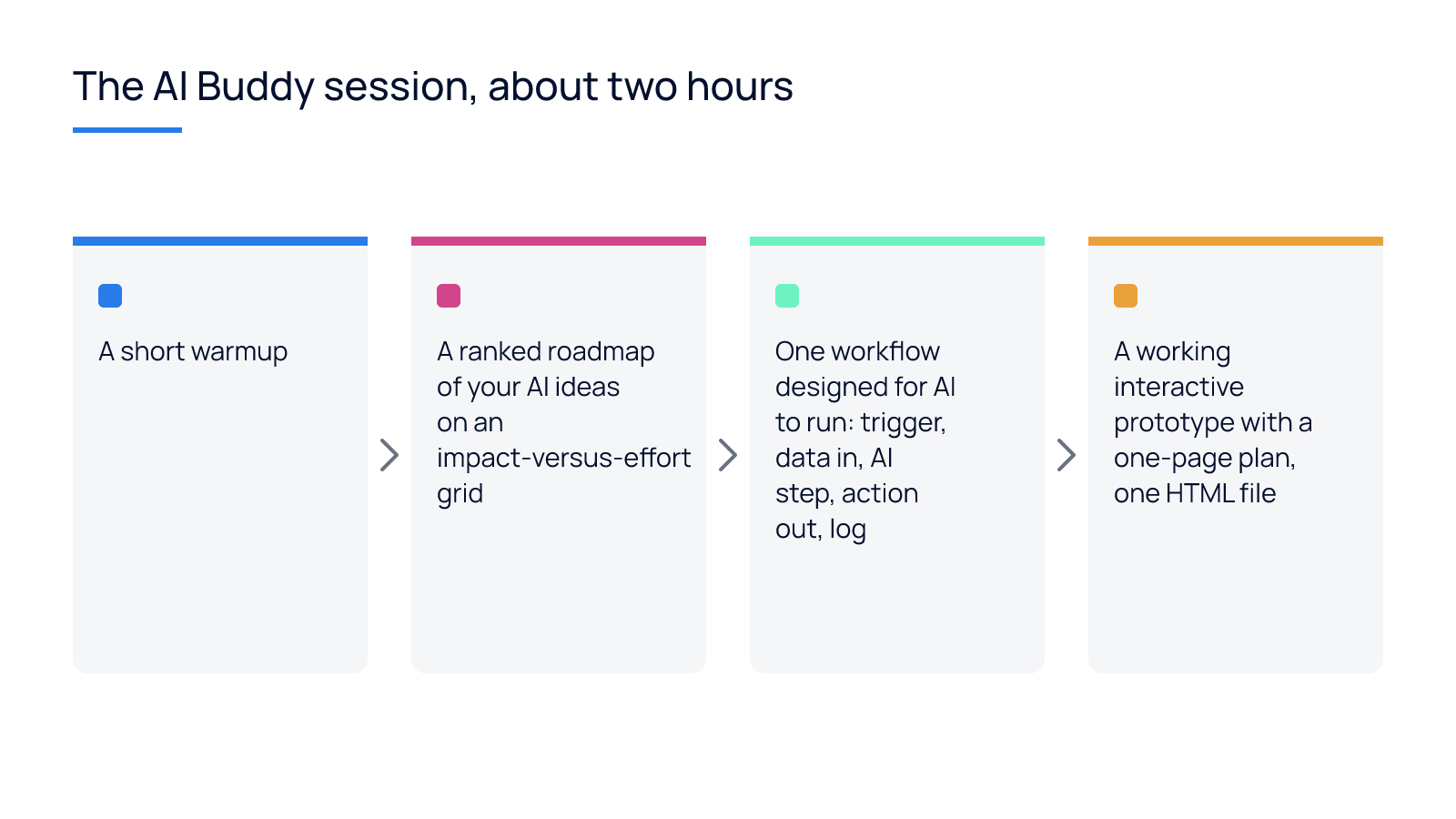
The Four Offices tells you how to think. This prompt is how you start building. It is the exact "AI Buddy" prompt we run at the AI Officer Institute keynote, a guided session of about two hours. Its governing idea is one line worth sitting with: with AI, the leverage moved to planning. A clear plan turns into a working build fast, so you spend most of the time planning and the build at the end is quick.
Paste it into Claude or ChatGPT and it runs a short warmup, then three activities. You walk out with three things you did not have on the blank page: a ranked roadmap of your AI ideas plotted on a high or low impact-versus-effort grid, one workflow designed well enough for AI to run it (a five-part straight line of trigger, data in, AI step, action out, log), and a working interactive prototype with a one-page plan attached, delivered as a single HTML file you open in your browser. It was built for a room, but it runs just as well solo.
That sequence is the point. You go wide before you go deep. You rank by impact and effort before you build a single thing. By the time the prototype appears, the hard work is already done, because it lived in the planning.
From roadmap to proof
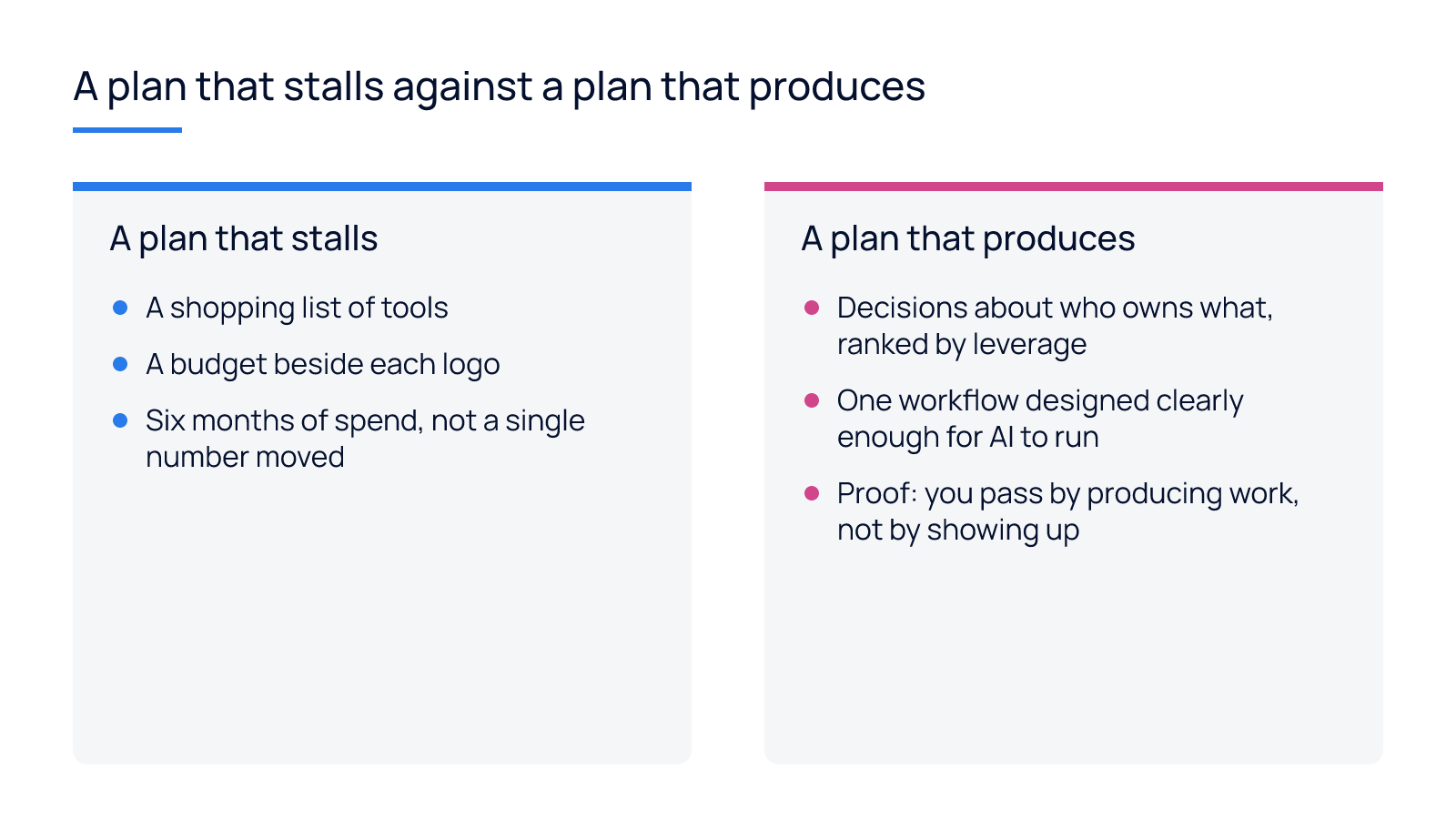
A roadmap you can defend is not a document of intentions. It is a set of decisions about who owns what, ranked by leverage, with one workflow designed clearly enough that AI can run it. That is the difference between a plan that stalls and one that produces. The prompt gets you a first draft of that plan in an afternoon.
But a draft is a starting line, not a standard. The leaders who make AI stick are the ones who can prove they built something that works, not the ones who attended a session on the topic. That is the principle behind our certification: you pass by producing work, not by showing up. The Perth pilot of our Leadership in the AI Era program scored a 77 NPS, and participants leave with three working AI deliverables rather than a certificate of attendance.
Start with the prompt. If you want the standard behind it, explore the Leadership in the AI Era certification and how you earn it.