Most executives sponsoring an AI pilot are watching the wrong thing.
They watch the model. Is it accurate enough? Will the next version be better? Will the vendor's demo hold up in production? Reasonable questions, every one, and almost never the reason a deployment fails.
Stanford's Enterprise AI Playbook, a study of 51 enterprise AI deployments, points somewhere else. The hard part of enterprise AI sits in data and workflows, not in the model. That finding changes who owns the problem. If the obstacle is not the technology, the obstacle belongs to the leader who sponsored the project.
- The Problem. Executives sponsoring an AI pilot watch the model, when the model is rarely why the deployment fails. Stanford's Enterprise AI Playbook, a study of 51 enterprise deployments, locates the hard part in data and workflows instead.
- The Insight. Data readiness, workflow design and ownership are not technical decisions. Each one resolves to a choice only a leader can make, which means delegating the pilot to the technology function is the stall.
- The Way Forward. Before the next pilot, name one person accountable for the workflow, map it step by step, and confirm the data it needs is ready. Start with the first research lesson on the Stanford study at aiolabz.com, and if you want the capability certified, explore the Leadership in the AI Era program and how you earn it.
What the Stanford study looked at
The Enterprise AI Playbook is not a survey of intentions or a forecast of adoption. It examines 51 deployments inside enterprises: AI that was actually put to work, with outcomes that can be inspected. The industry has an abundance of opinion about why AI projects stall and far less documented evidence drawn from projects that were tried, finished, or abandoned. This report is the second kind, which is why this institute cites it.
Fifty-one deployments is not a vast sample, and the report deserves to be read on its own terms rather than stretched into claims it does not make. But it is enough to reveal a pattern, and the pattern matches what we see in every cohort we teach in Vietnam, Dubai, and Washington, DC.
The number: 51 deployments, one pattern
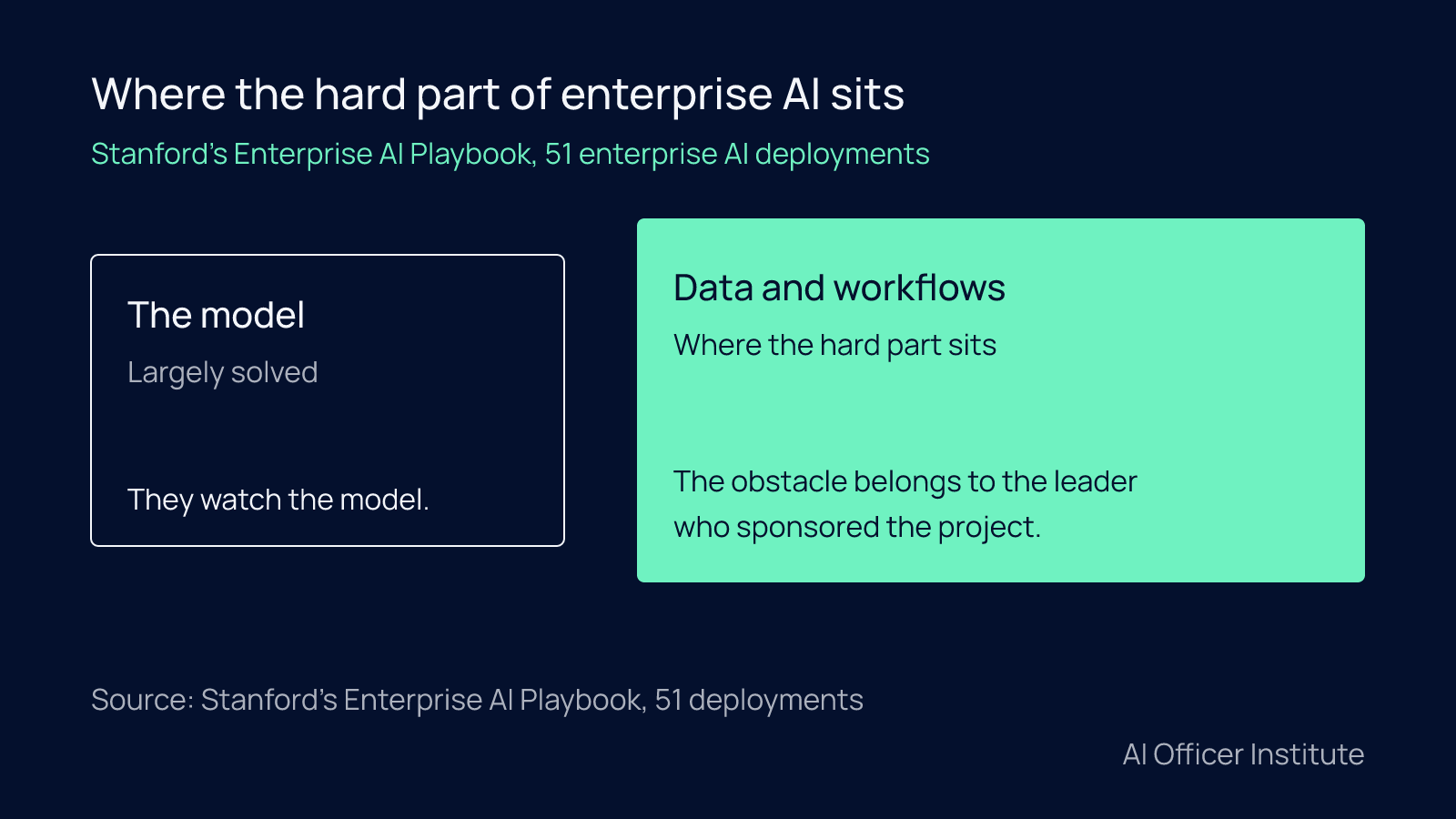
Across those 51 deployments, the Playbook locates the difficult work in data and workflows rather than in the model itself.
Consider what that means in practice. The model is the component the market has largely solved. Any enterprise can license a capable model this afternoon. What no vendor can supply is clean, accessible data the model can use, a workflow redesigned so the model's output actually changes a decision, and a person who owns that workflow end to end. That is where the effort went in the Stanford deployments, and it is where effort tends to disappear without result.
We made a version of this argument in AI Is Ready. Your Leaders Aren't. The Stanford study supplies the evidence from the enterprise side.
Three places a pilot stalls, none of them technical
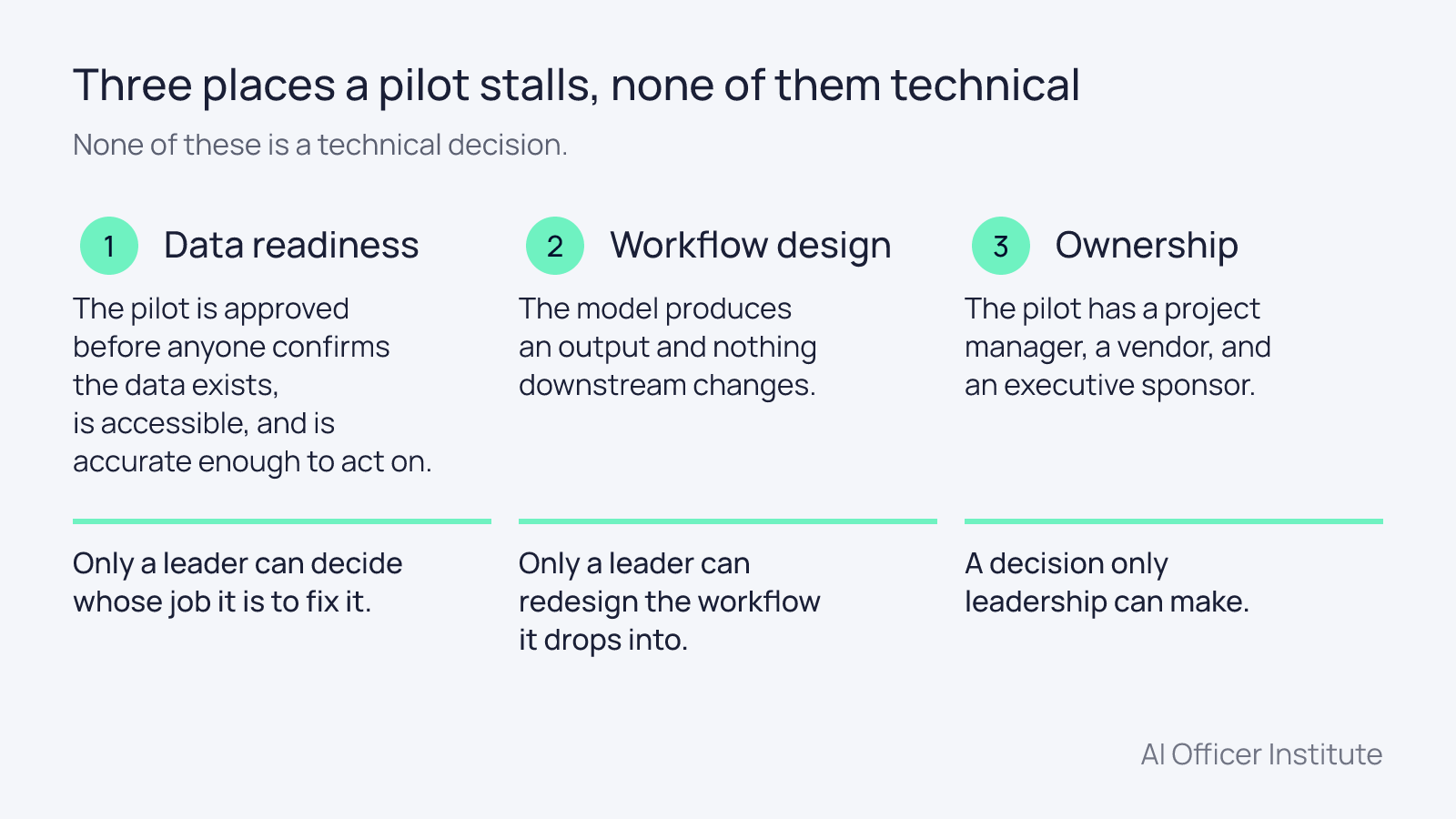
Read the Playbook alongside the stalled pilots we encounter and the same three failure points appear.
Data readiness. The pilot is approved before anyone confirms the data exists, is accessible, and is accurate enough to act on. Months later the team discovers the data sits in several systems, some of which nobody has permission to query.
Workflow design. The model produces an output and nothing downstream changes. Nobody redrew the process to put that output in front of the person who makes the decision, at the moment they make it.
Ownership. The pilot has a project manager, a vendor, and an executive sponsor. It does not have one person whose name is attached to the workflow working, as opposed to the model running.
None of these is a technical decision. A data engineer can tell you the data is not ready. Only a leader can decide whose job it is to fix it, by when, and what the pilot waits on until it is. A vendor can show you what the model produces. Only a leader can redesign the workflow it drops into. And ownership is, by definition, a decision only leadership can make.
Why this is the leader's job
AI projects stall on data readiness, workflow design and ownership, not on the technology. That makes it a leadership job.
This is the implication the Stanford findings force. If the hard part of enterprise AI were the model, executives could delegate it to the technology function and wait. Because the hard part is data, workflow, and ownership, delegating is the stall.
An executive who cannot map a workflow step by step, who does not know whether the data behind it is ready, and who has not named an owner is not sponsoring a pilot. They are funding an experiment with no hypothesis. The model will perform. The deployment will not.
This is why we hold leaders to a standard of produced work rather than attendance. Agreeing that AI is a workflow problem is easy to do in a conference session. Actually mapping the workflow, naming the owner, and confirming the data is ready is the work, and it is the work that separates leaders who can deploy from leaders who have read about deploying.
Three actions before the next pilot
before the next AI pilot, name one person accountable for the workflow, map the workflow step by step, and check that the data it needs is ready.
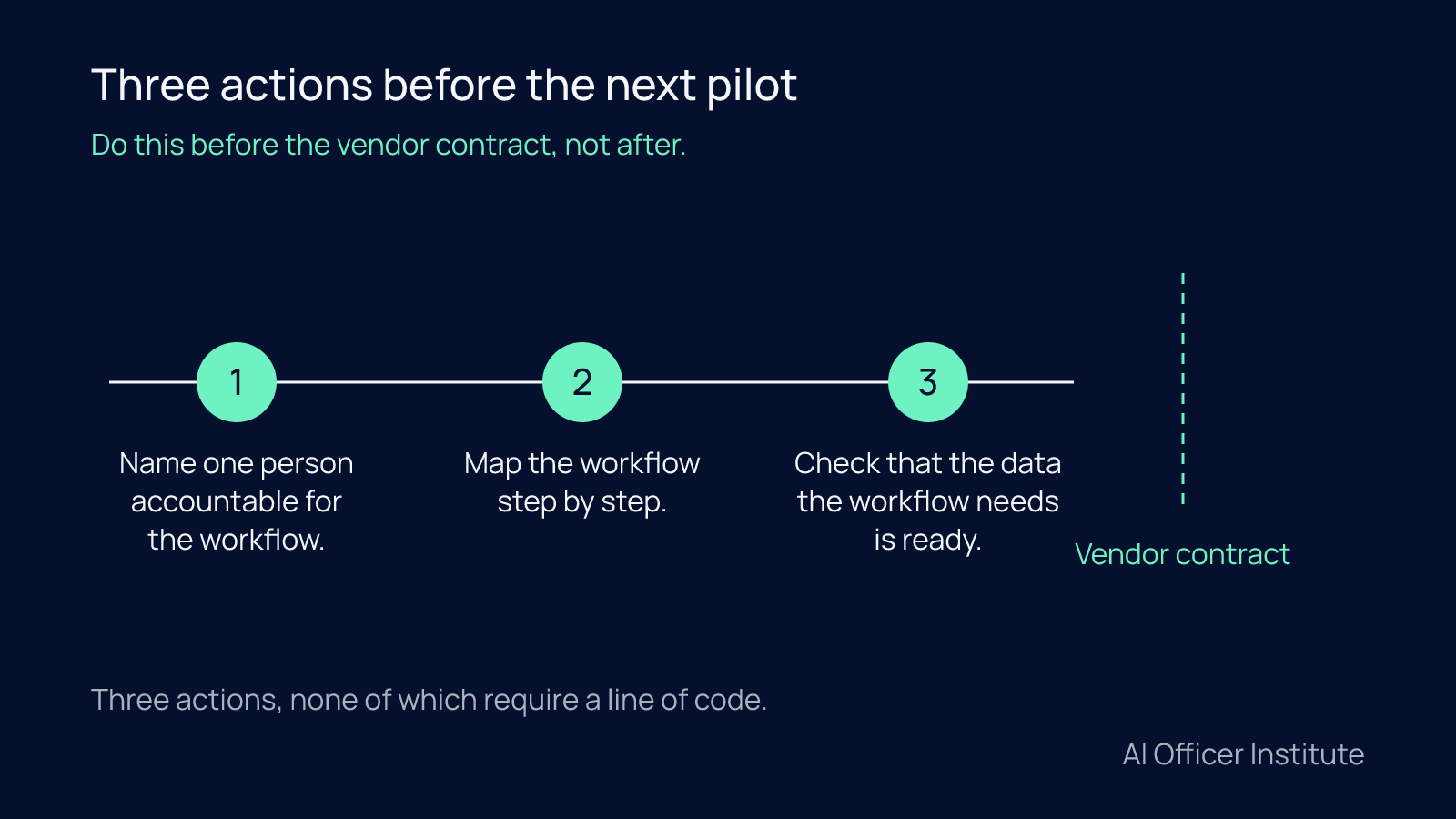
The action is short, and it precedes the technology entirely.
- Name one person accountable for the workflow. Not the model, not the project. The workflow. One name, written down, agreed with that person.
- Map the workflow step by step. Every input, every decision, every handoff, from the trigger to the outcome. Mark the exact step where the AI is meant to change something. If you cannot point to that step, there is no pilot yet.
- Check that the data the workflow needs is ready. For each step the AI touches, confirm the data exists, is accessible to the system that needs it, and is accurate enough to act on. Do this before the vendor contract, not after.
Three actions, none of which require a line of code. Every one of them is a leadership act.
Problem first. AI second. ROI always.
Problem first. AI second. ROI always.
That ordering is the principle underneath the Stanford findings and underneath everything this institute teaches. Start with the problem and the workflow that contains it. Bring AI to the step where it earns its place. Measure the return on the decision that changed, not on the model that ran.
Leaders who work in that order find that the technology is the easy part, which is exactly what 51 enterprise deployments suggest.
The next step: start with the first lesson
We have built a research lesson on Stanford's Enterprise AI Playbook: what the study of 51 deployments says, where the hard part sits, and how to run the three actions above on a workflow of your own. It is the first lesson, and it ends with work you produce, not a slide you watch.
Request access at aiolabz.com and start there.
If you want the capability certified, the Leadership in the AI Era program, built with Dr. Brooks Holtom of Georgetown's faculty and David Nilssen, runs across three series and requires three working AI deliverables to pass. The Perth pilot scored a 77 NPS. You pass by producing work, not by showing up.